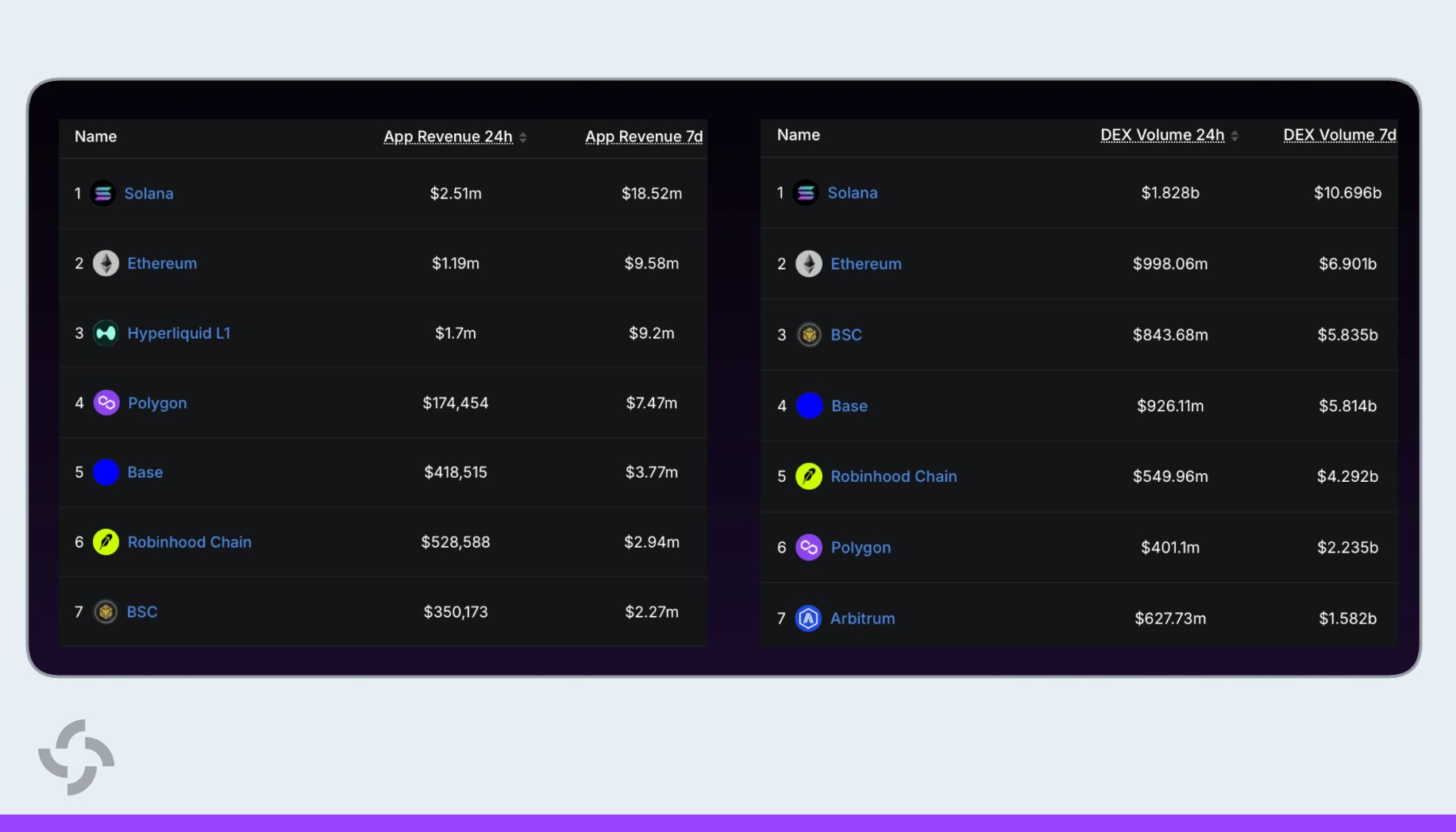
It is good to see that onchain trading holds up surprisingly well against CEXs, at least on paper.
Here are some of my findings and interpretations.
Solana has become large enough to outperform several major centralised exchanges in spot volume.
However, the claim that DEXs already represent more than 35% of all crypto trading volume is misleading, or depends heavily on the selected dates, provider and measurement method.
During 12–18 June 2026, Solana DEXs processed approximately $7.19B in spot volume.
Coinbase reportedly handled around $6.39B, Kraken $4.37B, Bybit $9.47B and Binance $34.39B during the same period.
Solana therefore clearly beat Coinbase and Kraken that week, but it did not beat Bybit or Binance.
The Solana Foundation itself confirms that Solana surpassed Coinbase and Kraken on both daily and weekly measurements during June.
The latest CoinGecko snapshots also show Solana’s current $1.73B daily DEX volume above Coinbase’s approximately $1.26B, Bybit spot’s $0.99B and Kraken’s $0.55B.
OKX was also displaying less than $1B in spot volume based on its BTC-denominated total.
That makes the claim plausible for certain recent days, but a daily snapshot does not prove that Solana has beaten all 4 exchanges consistently across several identical calendar weeks.
Solana controlled 30.6% of all blockchain DEX spot volume in Q1 2026, ahead of BSC at 24.5% and Ethereum at 23.7%.
According to Galaxy Research, Solana maintained its DEX-volume lead for a fifth consecutive quarter, even though its own quarterly volume fell by roughly 31%.
The market structure has also become more sophisticated:
Jupiter routes trades across multiple venues, while Raydium, Orca, Meteora, Phoenix and proprietary market makers provide different forms of liquidity and execution.
Solana’s proprietary AMMs can provide execution competitive with major CEXs on SOL and stablecoin pairs.
The volume is still heavily influenced by memecoins, bots and speculative token launches, but dismissing the entire market as memecoin gambling now ignores the development of stablecoin liquidity, professional market makers, tokenised assets and more advanced execution infrastructure.
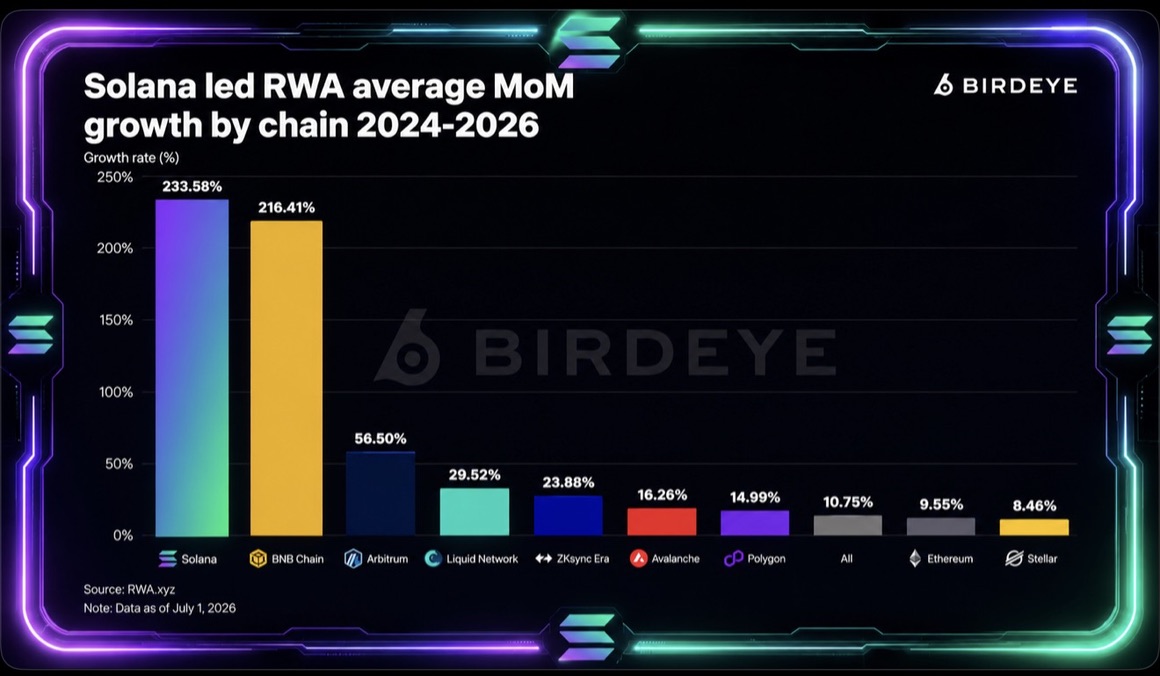
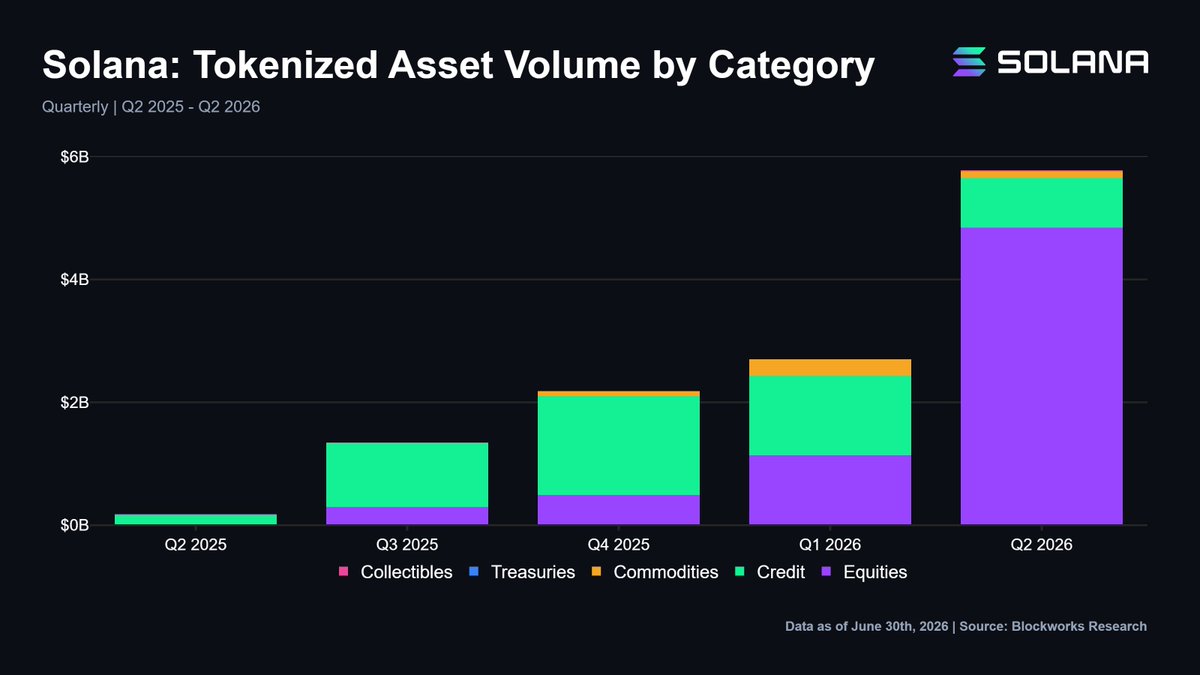
According to Solana’s own May ecosystem report, the network had more than $2.8B in RWA value, over $16B in stablecoins, $64.6B in monthly perpetual volume and 97% of cumulative onchain tokenised-equity spot volume.
These are ecosystem-reported figures and should not be confused with audited exchange statistics, but they show how Solana is expanding beyond native token speculation.
DEX perpetuals represented approximately 10.2% of perpetual volume in January 2026 and around 10% in April.
Centralised platforms therefore still controlled approximately 90% of this much larger segment.
CoinMarketCap’s June 2026 exchange report found that the tracked CEXs processed $5.44 in derivatives for every $1 in spot volume.
Solana beating Coinbase in spot does not mean it beats Coinbase, Bybit or OKX across their entire trading businesses.
Onchain transparency does not guarantee organic demand: Arbitrage, MEV, market-making bots, incentive farming, wash trading and repeated turnover of the same capital can generate large gross volume.
High volume does not automatically mean better market depth, narrower spreads, lower slippage or greater institutional capacity.
Transactions versus users: Solana’s 81M daily transactions and 1.86M active addresses do not represent 81M trades or 1.86M individual humans.
Automated systems can produce enormous activity.
A dollar traded 100 times produces $100 of reported volume without adding $100 of new capital.
CEX dominance is weakening, but the numbers deserve more than a recycled bullish headline.
 Solana (SOL)
 DJ Trader TA_Analyst A13.21K @0xDeejay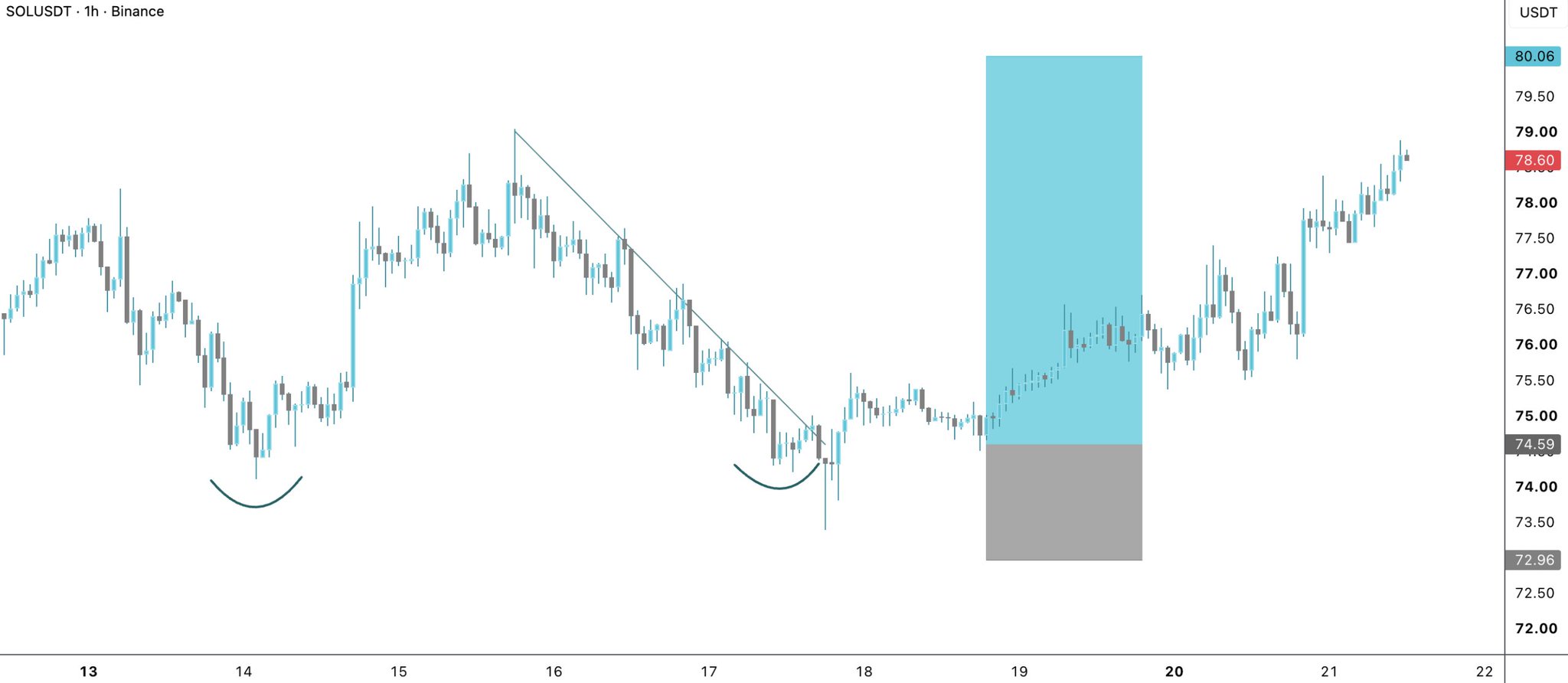
 Dragnipur「🦑」 OnChain_Analyst DeFi_Expert B2.97K @_Dragnipur_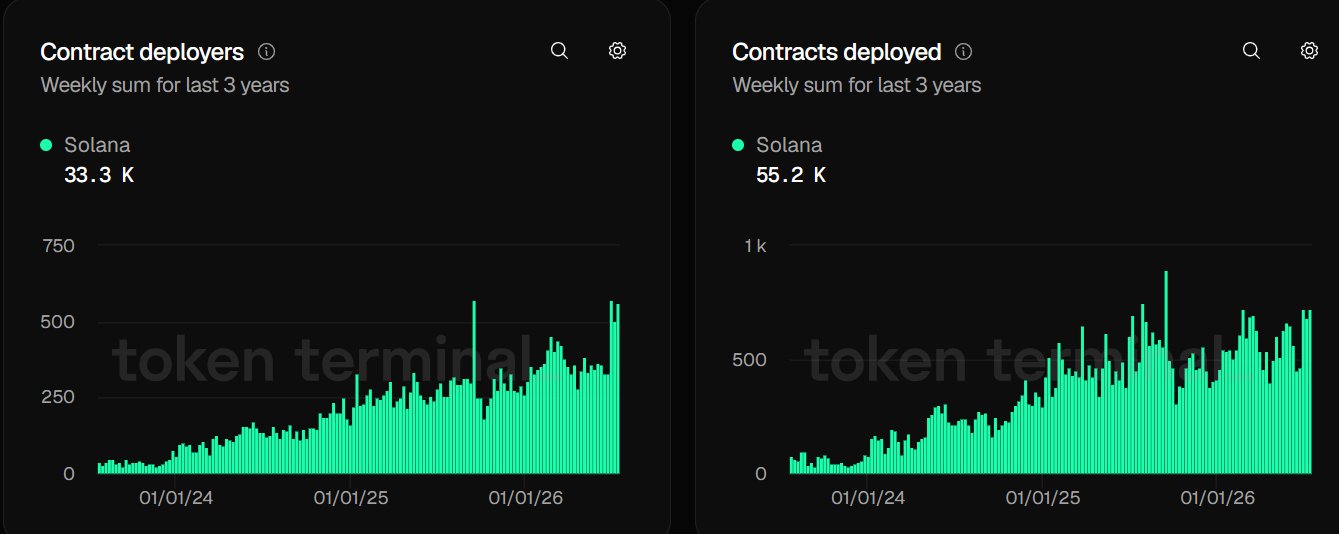
 MASTR Security_Expert OnChain_Analyst B30.60K @MastrXYZ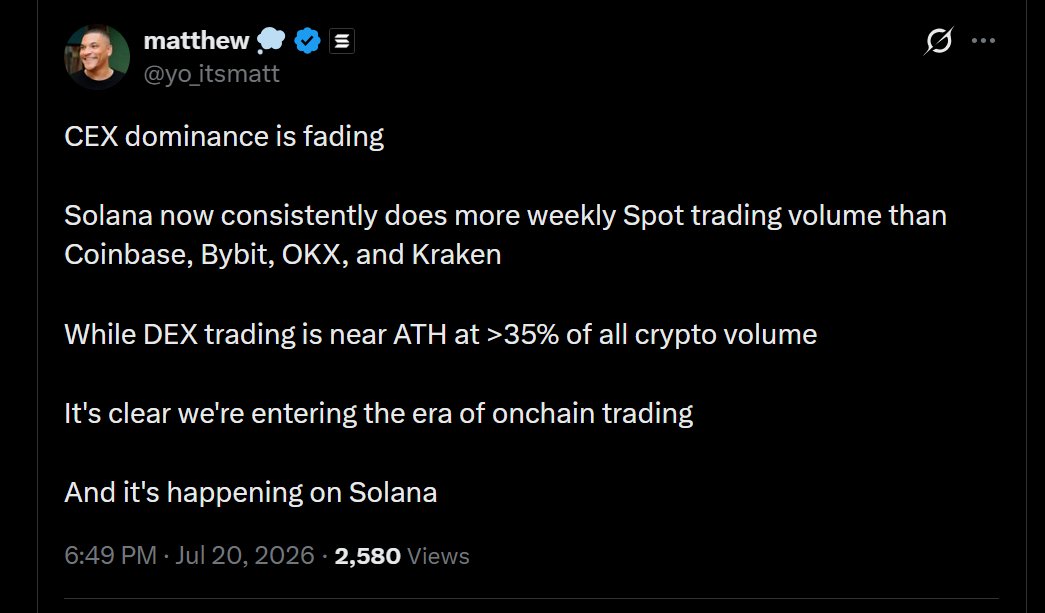
 matthew 💭 D16.36K @yo_itsmatt5 4 757 Original lesen >Trend von SOL nach VeröffentlichungNeutral
 Yeminiz 💙🫵 Educator Founder C57.27K @_yeminiz
 ZAYN🌹 D5.60K @Bigmelissa_1
 65 29 434 Original lesen >Trend von SOL nach VeröffentlichungExtrem bullisch
 icefrog.◎ 🇻🇳 Quant OnChain_Analyst C7.29K @icefrog_sol
 curb VC OnChain_Analyst C77.99K @CryptoCurb
 111 36 3.96K Original lesen >Trend von SOL nach VeröffentlichungExtrem bullisch
 Layergg OnChain_Analyst Researcher C125.32K @layerggofficial
 Solana Media Community_Lead D3.90M @solana
 14 1 6.59K Original lesen >Trend von SOL nach VeröffentlichungExtrem bullisch