Canton Network and its $CC token is a Wall Street institutional-grade blockchain settlement layer.
$CC : Review 📜
What if the most boring corner of finance, daily Treasury repo settlement worth hundreds of billions, was quietly moving onto a public blockchain that almost no one in CT talks about?
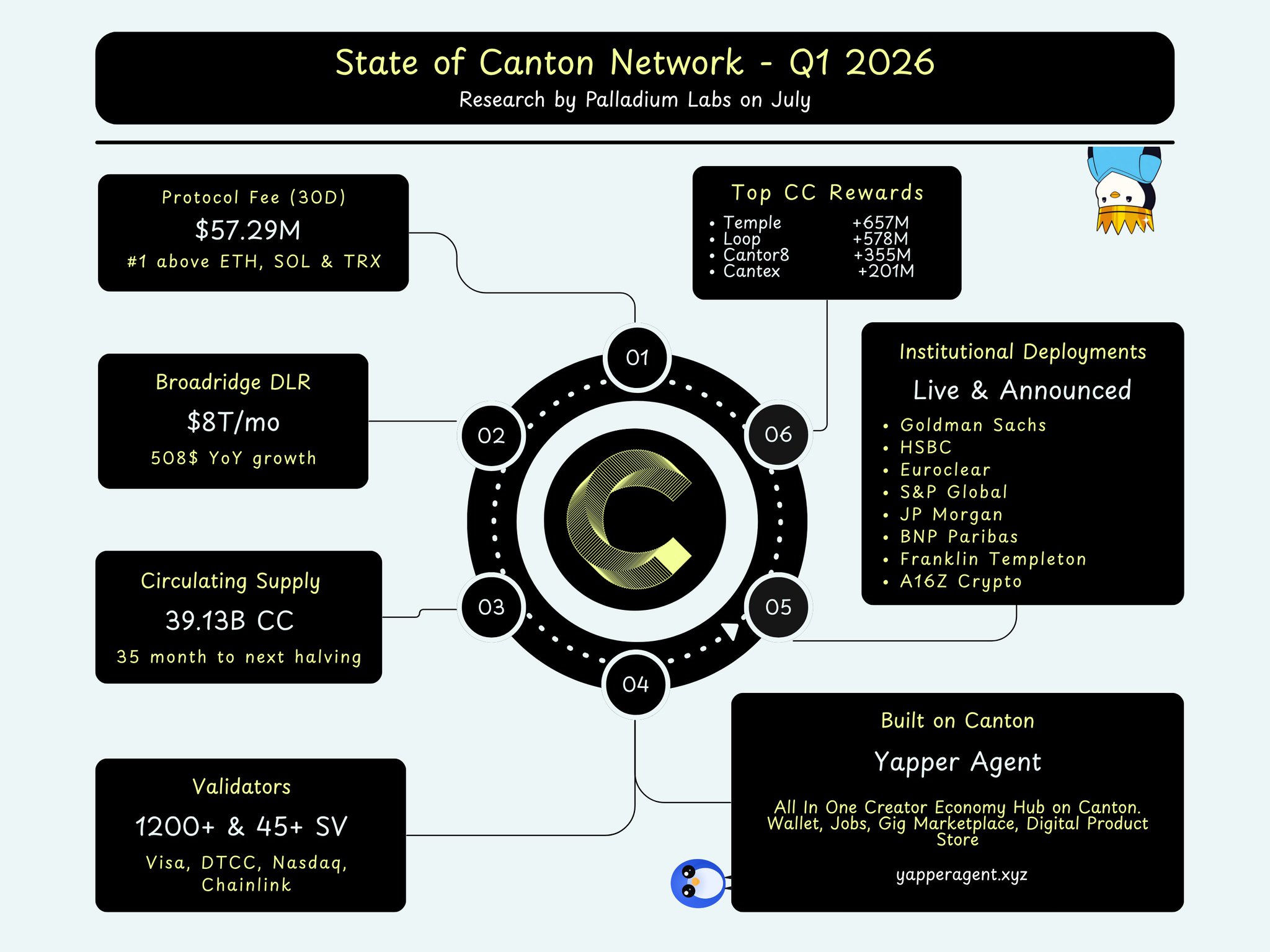
Meet Canton Network, the institutional L1 already processing $400B+ in daily US Treasury repo through a Broadridge subnet, with DTCC tokenizing Treasuries, JPMorgan migrating tokenized deposits, Goldman Sachs issuing debt onchain, and a16z crypto leading a $355M round at a $2B valuation.
While the rest of crypto debates decentralization theater, Canton is busy becoming Wall Street's settlement layer.
Let's explore how Canton is rebuilding capital markets infrastructure for the onchain era. 👇
⚪ Canton Network at a Glance
Canton Network is a public, privacy-enabled Layer 1 blockchain designed from the ground up for regulated financial markets. Built by Digital Asset and powered by the Daml smart contract language, Canton solves a problem most blockchains can't: how to deliver privacy, composability, and regulatory compliance simultaneously without forcing institutions into private side-chains or wrapped assets.
The network uses a two-tier consensus model with Super Validators (large institutions like Visa, Apollo, Circle, Chainlink, Goldman Sachs) and ordinary Validators, coordinated by the Global Synchronizer that orders transactions across subnets without seeing private transaction data. Daml's sub-transaction privacy ensures only counterparties see deal details, while the network validates integrity.
Marketplace Insight: Canton is the rarest thing in crypto right now: a blockchain whose institutional adoption story is real, verifiable, and audited by regulators. With BNY, Nasdaq, and S&P Global already strategic investors, and a16z crypto leading the latest round at $2B, Canton is being positioned as the settlement layer for tokenized capital markets. The criticism from crypto purists about "is it really decentralized" is fair, but the counter is simpler: it is the only public blockchain that institutions of this scale are actually using in production.
⚪ Mission
Canton's mission is to enable native onchain assets, not wrapped versions, with the privacy, compliance, and atomic settlement that regulated financial markets require. The goal is to become the infrastructure layer where tokenized securities, collateral, Treasuries, deposits, and payments all settle in one composable environment, while preserving the privacy controls that make institutional participation possible.
🔵 A Brief History
Canton's origin traces back to 2014, when Yuval Rooz and Eric Saraniecki left DRW Trading to start Digital Asset, joined shortly after by Shaul Kfir, the cryptographer who created libsnark, the library that would later power Zcash. The thesis was simple but ambitious: capital markets would move onchain, and when they did, privacy could not be optional.
For nearly a decade, Digital Asset built Daml as an enterprise-grade smart contract language and deployed it across private, permissioned environments used by institutional participants including BNP Paribas, Goldman Sachs, and HSBC. The original Daml and Canton protocol were introduced in a February 2020 whitepaper, focused on multi-party distributed applications with built-in privacy.
In January 2024, Digital Asset published an updated Canton Network whitepaper that expanded the vision into a public, interoperable network architecture. Canton Network launched publicly in 2024, with the Canton Coin Token Generation Event in June 2024.
Throughout 2025, institutional momentum accelerated. December 2025 brought strategic investments from BNY ($57T in client assets), Nasdaq, S&P Global, and iCapital. The Global Synchronizer Foundation was formed under the Linux Foundation to govern the network. By early 2026, more than 40 Super Validators were active, including Visa, Apollo, Circle, Chainlink, Cumberland, and Broadridge.
2026 has been the breakout year for institutional production. Fireblocks integrated Canton in February. HSBC completed its Tokenized Deposit Service pilot on Canton in April. Nomura, Mizuho, and the Japan Securities Clearing Corporation began trialing tokenized Japanese Government Bonds on Canton in April. 21Shares launched a Canton Network ETF. Logical Synchronizer Upgrades shipped in April, enabling zero-downtime protocol upgrades critical for live financial markets. And in June 2026, Digital Asset closed a $355M round led by a16z crypto at a ~$2B valuation, with participation from BNP Paribas, HSBC, ADIA, Apollo, Citadel Securities, CME Group, Coinbase, Polychain, ABN AMRO, SBI, Tradeweb, and over 20 other major investors.
🔵 Ecosystem Narrative
Canton's ecosystem is built around one core principle. Privacy, composability, and compliance are not three separate goals to trade off, they are one integrated design that institutions can actually use.
Key dynamics include:
➛ Network of networks architecture. Canton is not a single ledger but an interoperable web of subnets coordinated by the Global Synchronizer. Each application or institution can run its own subnet with privacy controls, while atomic settlement across subnets remains intact through the synchronization layer.
➛ Sub-transaction privacy via Daml. The Daml smart contract language enforces a need-to-know visibility model by design. Counterparties see deal details, validators see only enough to confirm integrity, and the mediator only sees the informee tree (participant identities, transaction shape, confirmation responses). The sequencer only sees encrypted payloads, which structurally eliminates MEV extraction.
➛ Production-grade institutional workloads. Broadridge processes $400B+ in daily US Treasury repo transactions on a Canton subnet. Tradeweb runs 24/7 repo trading and settlement. DTCC is tokenizing DTC-custodied Treasuries via ComposerX. JPMorgan is migrating tokenized deposits to Canton. Goldman Sachs has issued debt instruments and a money market fund on Canton. HSBC, Nomura, and Mizuho are all in active pilots.
➛ Super Validator institutional base. 40+ Super Validators including Visa, Apollo, Circle, Chainlink, Cumberland, Broadridge, and Goldman Sachs (planned). The validator set is the institutional financial system itself, which is both Canton's biggest strength and the source of ongoing decentralization debate.
➛ Burn-mint equilibrium tokenomics. Fees paid in $CC are permanently burned. New $CC is minted as rewards to fee-generating applications, validators, and super validators. No pre-mine, no presale, no VC allocation, no founder token allocation. Every $CC token in circulation was earned through network utility.
➛ Institutional integrations stack. Fireblocks custody integration (Feb 2026), WalletConnect integration bringing Canton to 700+ wallets and 55M+ users, TRM Labs compliance partnership, 21Shares Canton Network ETF, Chainlink as a Super Validator and oracle provider.
➛ Dual governance structure. Digital Asset builds the core technology. The Canton Foundation under the Linux Foundation stewards the network. The Global Synchronizer Foundation governs the interoperability layer. This separation aligns with institutional governance norms rather than pure token voting.
⚪ Token Utilities
$CC is the native utility token of the Canton Network with utility tightly bound to actual network activity:
➛ Network Fees: All Global Synchronizer fees are paid in CC and permanently burned, tying token supply to real usage.
➛ Super Validator Rewards: CC is minted as rewards to entities running the Global Synchronizer (Super Validators), with rewards determined by a mining curve including halvings.
➛ Validator Rewards: Entities running full nodes that provide network access earn $CC rewards.
➛ Application Provider Rewards: Application builders and operators earn
$CC for bringing real utility and fee-generating activity to the network. Rewards are merit-based, not allocated to investors or insiders.
➛ Burn-Mint Equilibrium: Approximately 2.5B CC are minted and burned annually, with supply dynamics tied directly to network utility rather than fixed emissions schedules.
➛ Utility-Earned Distribution: No pre-mine, no presale, no founder allocation, no VC token allocation. Every CC in circulation was earned by contributing real network value.
⚪ Key Features
➛ Configurable Privacy: Sub-transaction privacy via Daml enforces need-to-know visibility, with counterparties seeing deal details and the network validating integrity without exposure.
➛ Atomic Cross-Application Settlement: Combine actions across multiple assets and applications in one indivisible operation without bridges or messaging hacks.
➛ Two-Tier Consensus: Super Validators (institutional-grade) plus ordinary Validators, coordinated by the Global Synchronizer.
➛ Unlimited Horizontal Scalability: Subnets can be added without consensus across the global network, enabling near-unbounded throughput.
➛ Zero-Downtime Protocol Upgrades: Logical Synchronizer Upgrades (April 2026) allow live financial markets to upgrade without halts.
➛ Daml Smart Contract Language: Open-source, formally verifiable language built specifically for multi-party financial workflows with built-in authorization and privacy.
➛ Standards-Compliant Cryptography: Built with NIST-approved primitives and HSM support, GDPR-compliant by design, with auditability built into the protocol.
🔵 Meet the Canton Team
Canton is built by Digital Asset, founded in 2014 by a team that combines deep institutional trading experience from DRW and Citadel with foundational cryptography expertise that helped shape modern blockchain privacy.
▶️ Core Members:
➛ Yuval Rooz [ @YuvalRooz ] - Co-Founder & CEO | Previously managed an electronic algorithmic trading desk at DRW and joined DRW's venture arm. Earlier worked as a trader and developer at Citadel. Holds a B.S. in Electrical Engineering from Georgia Tech. Board Member and Treasurer of the Global Synchronizer Foundation. Member of the US CFTC Global Market Advisory Committee. Has testified before the US House Committee on Financial Services on digital assets.
➛ Shaul Kfir [ @ShaulKfir ] - Co-Founder & COO | Cryptographer who created libsnark, the foundational cryptography library that later powered Zcash and remains one of the most important blockchain privacy tools ever built. Spent a decade as Chief Architect of Digital Asset, building Daml and the Canton protocol from the ground up. Co-founder of Bits of Gold.
➛ Eric Saraniecki [ @wesarn_real ] - Co-Founder & Head of Network Strategy | Co-founder of Cumberland Mining, one of the world's largest crypto OTC market makers (operating since 2012). Left DRW with Rooz to start Digital Asset. Leads network strategy, institutional partnerships, and ecosystem development.
➛ Ratko Veprek - CTO | Holds a PhD in distributed systems. Leads engineering across the Daml runtime, Canton protocol, and Global Synchronizer infrastructure.
➛ Emnet Rios - CFO | 25 years in finance, HR, IT, and operations. Has raised $450M+ for Digital Asset across multiple funding rounds.
➛ Bernhard Elsner - CPO | Involved with Canton since its earliest conceptual stages in 2020. Owns product strategy across Daml, Canton, and the broader institution toolchain.
➛ Kelly Mathieson - CBDO | 30 years in capital markets at JPMorgan and Goldman Sachs. Leads institutional business development and Super Validator onboarding.
➻ Jonathan Isaac - CMO | Drives Canton's brand, communications, and institutional marketing.
➛ Edward Newman - CISO | Leads security architecture, key management, and operational security for Canton's institutional deployments.
➛ Canton Foundation (Linux Foundation) - Network steward responsible for governance, evolution, and decentralization of the protocol.
➛ Global Synchronizer Foundation - Governance body for the Global Synchronizer interoperability layer, with members including Broadridge, Cumberland, Chainlink Labs, and other Super Validators.
🔵 Ratings
➛ Use Case: ★★★★✦ (4.5/5) - Canton has what every institutional blockchain has been promising for a decade: actual institutional usage at scale. $400B+ in daily Treasury repo on the Broadridge subnet, DTCC tokenizing Treasuries, JPMorgan migrating tokenized deposits, Goldman Sachs issuing debt and money market funds onchain, HSBC tokenized deposit pilot complete, Nomura and Mizuho trialing JGBs. The infrastructure is being used in production by the largest financial institutions in the world. Add Daml's privacy-by-design architecture, atomic cross-application settlement, and the only public L1 that institutions can actually use without compromising compliance, and the use case is uniquely strong. The 0.5 deduction is for the legitimate decentralization critique. The Super Validator set is largely the same financial institutions that already control TradFi, which limits Canton's relevance for crypto-native use cases and creates regulatory capture risk over time.
➛ Tokenomics: ★★★★ (4/5) - Canton's tokenomics are genuinely unusual and in many ways exemplary. No pre-mine, no presale, no VC allocation, no founder token allocation. Every $CC in circulation was earned through real network contribution. The burn-mint equilibrium ties supply directly to fee revenue and utility, with approximately 2.5B CC minted and burned annually. This is one of the cleanest utility-based token models in the entire market. The 1-point deduction is for the unlimited max supply structure, which depends on burns keeping pace with mints to maintain value. The $5.8B+ market cap is high relative to current CC fee burn rates, and if mint outpaces burn during low-activity periods, dilution becomes a real risk. The model is elegant but requires sustained institutional usage to work.
➛ Audits: ★★★★✦ (4.5/5) - Canton's security model is fundamentally different from typical EVM audits and arguably stronger by design. The Daml language is built for formal verification, with OpenZeppelin developing dedicated tooling: daml-lint (Rust-based static analysis), daml-props (property-based testing in pure Daml), and daml-verify (formal verification via the Z3 prover for invariants covering conservation, division safety, temporal ordering, and collateral management). Standards-compliant cryptography (NIST-approved primitives), HSM and KMS support, and GDPR compliance built into the protocol. MEV extraction is structurally impossible because the sequencer only sees encrypted payloads, eliminating an entire class of exploits. The 0.5 deduction is for the relative newness of Daml-specific security tooling versus the decade-plus EVM audit ecosystem, but the formal verification foundation is among the strongest in the entire L1 category.
➛ Community: ★★★★✦ (4.5/5) - Canton's community is one of the most institutionally powerful in crypto, even if it doesn't look like the typical crypto-Twitter base. 700+ ecosystem participants, 40+ Super Validators including Visa, Apollo, Circle, Chainlink, Goldman Sachs, Broadridge, and Cumberland. Backed by literally every major Wall Street name: BNY ($57T AUM), Nasdaq, S&P Global, iCapital, a16z crypto, ADIA, Apollo, BNP Paribas, HSBC, Citadel Securities, CME Group, Coinbase, Polychain, ABN AMRO, SBI, and Tradeweb. The 21Shares Canton Network ETF and WalletConnect integration (700+ wallets, 55M+ users) extend access beyond institutional walls. As Yuval Rooz put it, Canton's community "fucking earned it." The 0.5 deduction is for the lack of a traditional crypto-native retail community, since Canton deliberately did not airdrop and is built around institutional adoption rather than meme-driven attention.
🔵 Conclusion
Canton Network is the most institutionally credible blockchain in crypto, and that statement is no longer aspirational. It is being used today, in production, by DTCC, JPMorgan, Goldman Sachs, HSBC, Broadridge, Tradeweb, and dozens of other entities that collectively run the global financial system. The $355M round led by a16z crypto at a $2B valuation, joined by BNY, Nasdaq, S&P Global, ADIA, Apollo, Citadel Securities, CME, Coinbase, and others, is the clearest signal yet that traditional finance is taking Canton seriously as the settlement layer for tokenized capital markets.
The Daml smart contract language, the Global Synchronizer architecture, sub-transaction privacy, atomic cross-application settlement, and the burn-mint equilibrium tokenomics are all genuinely novel design choices that solve real institutional problems. Yuval Rooz, Shaul Kfir, and Eric Saraniecki built this team across nearly 12 years of patient development, well before institutional blockchain adoption became a hot narrative.
The bull case is simple. If trillions of dollars of capital markets activity are moving onchain over the next decade, and if institutions actually need privacy, compliance, and atomic settlement to make that move, then Canton is the only public network architected from day one for that workload.
Few crypto projects can claim institutional partners of this caliber, production workloads at this scale, and a team with this much credibility in capital markets. Canton actually can.