Ethereum (ETH)

$2,355.63  +1.09%  24H

ソーシャル・センチメント・インデックス(SSI)

マーケット・パルス・ランキング(MPR)

Xへの投稿

  • That Martini Guy ₿ Trader Influencer C
     710.97K  @MartiniGuyYT

    🚨BREAKING MACHI BIG BROTHER IS BACK IN THE GREEN! 🚀 Thanks to the market rally, he’s up $1.27M in the last 24 hours. Current holdings: - 13,175 $ETH ($31M) - 360 $BTC ($28.33M) - 75,000 $HYPE ($3.13M) https://t.co/YOyQu5dsQI

     8  2  365
    オリジナル >
    リリース後のETHのトレンド
     非常に強気
    Machi Big Brother made $1.27M profit during the market rally, with strong performance in ETH, BTC, and HYPE holdings.
  • BuLL 牛 Influencer Educator C
     472.20K  @bull_bnb
    BuLL 牛 Influencer Educator C
     472.20K  @bull_bnb

    My agent been reading the tape for 16 days. Today's verdict is full send, ETH runners loading. Either it prints and we know it's seeing what I trained it to see, or we sharpen the blade. https://t.co/2MyG8Pmo3P

     157  18  13.57K
    オリジナル >
    リリース後のETHのトレンド
     非常に強気
    The author is strongly bullish on ETH, recommending a decisive increase in position today, ready to go all‑in.
  • Maelius TA_Analyst Trader A
     9.50K  @MaeliusCrypto
    Maelius TA_Analyst Trader A
     9.50K  @MaeliusCrypto

    $ETH outperformance around the corner? We need some strength soon. However, usually it comes out of nowhere. https://t.co/UyA2BKMRGr

     219  12  9.23K
    オリジナル >
    リリース後のETHのトレンド
     強気
    The ETH/BTC technical chart shows a potential breakout, possibly replicating the strong performance against BTC seen in 2017.
  • Pi News Media Influencer D
     1.14M  @PiNewsMedia

    🚨NEW: Anatoly Yakovenko warns that Ethereum L2s are not quantum-safe, urging users to “abandon all hope.” Quantum risk debate is heating up… https://t.co/8iSgO1LA9F

     7  1  595
    オリジナル >
    リリース後のETHのトレンド
     非常に弱気
    Solana founder warns that Ethereum L2s have quantum insecurity risk, urging users to abandon hope.
  • That Martini Guy ₿ Trader Influencer C
     710.97K  @MartiniGuyYT

    🐂BULLISH ETH JUST CLIMBED BACK OVER $2,380 🚀 https://t.co/tPUHmJQ2dR

     96  10  1.73K
    オリジナル >
    リリース後のETHのトレンド
     非常に強気
    Ethereum broke above $2,380, showing strong bullish momentum.
  • 很大很大的橙子 Trader Derivatives_Expert B
     91.13K  @0xVeryBigOrange
    蓝狐 OnChain_Analyst Security_Expert B
     73.20K  @lanhubiji

    In the past two days, many in the English community have mentioned that after the Glamsterdam upgrade, the Ethereum L1 gas limit will be raised directly from the current 60M to a lower bound of 200M. What does this mean? It means the L1 execution capacity will be more than three times larger, with expectations of further doubling in the future. Coupled with technologies such as ePBS, BAL optimization, and gas repricing, L1 throughput will increase significantly. As long as demand does not surge abruptly, L1 fees could stay at a very low level for a long time, possibly becoming imperceptible to users. So, what does this mean for Ethereum L2s or other high-performance blockchains? First, Ethereum L1 fees approach those of L2s, even becoming almost identical.
Currently, ordinary L1 transfer fees are already very low (about $0.1‑$0.4). After the upgrade, if gas prices are further pushed down to the 0.01‑0.05 gwei level, many simple transactions can be executed directly on L1 without needing L2. First, it adds a layer of bridge/withdrawal cost; second, L1 remains more secure.
The once‑core selling point of L2s—‘much cheaper than L1’—will be markedly weakened. Second, L2 economic models will need adjustment. L2s also need to batch their data onto L1 (data availability). Cheaper L1 is beneficial for L2s (rollup costs drop), but as L1 becomes “sufficient and cheap,” many applications may choose to deploy directly on L1, especially in DeFi, NFT, or gaming scenarios that do not require extremely high TPS. This forces L2s to upgrade; to stay competitive, L2s must differentiate through speed, custom execution environments, and specific application optimizations (such as zk proof speed, account abstraction, perp‑specific chains, etc.) rather than relying solely on ‘cheaper’ fees. The evolutionary trend is that, aside from a few general‑purpose L2s like Base and Arbitrum, the future will see more application‑specific L2s such as Lighter, Ronin, etc., which may also lead Polymarket to adopt an Ethereum L2 solution. In the short term, Ethereum L1 may appear to lose a lot of fee revenue; however, in the long term, this enhances Ethereum’s ecosystem control and will eventually translate into higher fee income. Finally, the pressure on high‑performance public chains increases significantly.
High‑performance chains previously used “ETH L1 being slow and expensive” as a target. Now ETH L1 is suddenly “fast and cheap + highest security + deepest liquidity + most complete developer ecosystem,” which severely compresses the differentiated advantages of high‑performance chains.
Unless they can continue to lead substantially in actual TPS, finality, developer experience, and capital efficiency, many projects and users may reassess whether it is worth leaving the Ethereum ecosystem. This creates a trend where, aside from one or two high‑performance chains, the others will gradually become part of the Ethereum ecosystem, and an increasing number of projects and users will move toward Ethereum L1 and L2. This upgrade marks a return to Ethereum’s “single‑chain narrative”: L1 first scales its capacity, and L2s continue to build on top. For L2 projects: the short term is favorable (cost reduction), the medium term brings pressure (they must prove they are more valuable than L1). For other public chains: the competitive threshold is raised again.

     28  9  4.07K
    オリジナル >
    リリース後のETHのトレンド
     強気
    After the ETH upgrade, the gas limit rises to 200M, fees drop significantly, increasing competitive pressure on L2.
  • SolarEtherPunk🏄 OnChain_Analyst Educator B
     2.88K  @SolarEtherPunk
    Cantonese Cat 🐱🐈 TA_Analyst Trader B
     79.74K  @cantonmeow

    #Ethereum https://t.co/tNMtf5I7K2

     65  5  3.28K
    オリジナル >
    リリース後のETHのトレンド
     強気
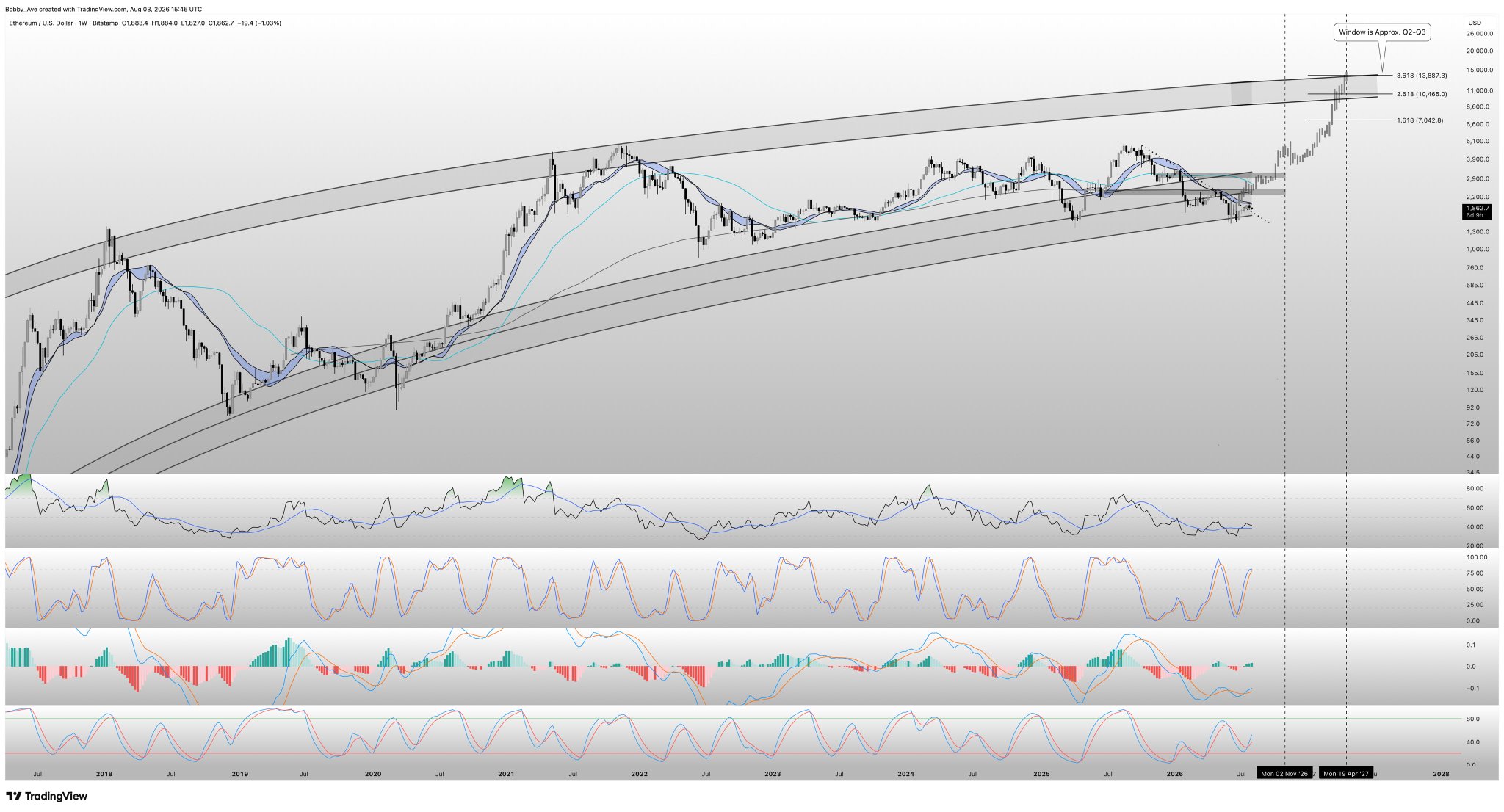
    Technical analysis of Ethereum shows it is in a historic bottom zone, indicating a future price uptrend.
  • 吴说区块链 Media Educator D
     176.66K  @wublockchain12

    According to Wu, chain analyst @ai_9684xtpa monitored that address 0x55e…3DF26 accumulated deposits of 6,200 ETH to Binance over the past 24 hours, worth about $14.54 million, with an average deposit price of $2,345. Currently, the address still holds about $17.84 million worth of ETH in Spark. https://t.co/twV1CgwTP4

     1  0  1.28K
    オリジナル >
    リリース後のETHのトレンド
     弱気
    Large ETH deposit to Binance may create short-term sell pressure
  • 蓝狐 OnChain_Analyst Security_Expert B
     73.20K  @lanhubiji

    In the past two days, many in the English community have mentioned that after the Glamsterdam upgrade, the Ethereum L1 gas limit will be raised directly from the current 60M to a lower bound of 200M. What does this mean? It means the L1 execution capacity will be more than three times larger, with expectations of further doubling in the future. Coupled with technologies such as ePBS, BAL optimization, and gas repricing, L1 throughput will increase significantly. As long as demand does not surge abruptly, L1 fees could stay at a very low level for a long time, possibly becoming imperceptible to users. So, what does this mean for Ethereum L2s or other high-performance blockchains? First, Ethereum L1 fees approach those of L2s, even becoming almost identical.
Currently, ordinary L1 transfer fees are already very low (about $0.1‑$0.4). After the upgrade, if gas prices are further pushed down to the 0.01‑0.05 gwei level, many simple transactions can be executed directly on L1 without needing L2. First, it adds a layer of bridge/withdrawal cost; second, L1 remains more secure.
The once‑core selling point of L2s—‘much cheaper than L1’—will be markedly weakened. Second, L2 economic models will need adjustment. L2s also need to batch their data onto L1 (data availability). Cheaper L1 is beneficial for L2s (rollup costs drop), but as L1 becomes “sufficient and cheap,” many applications may choose to deploy directly on L1, especially in DeFi, NFT, or gaming scenarios that do not require extremely high TPS. This forces L2s to upgrade; to stay competitive, L2s must differentiate through speed, custom execution environments, and specific application optimizations (such as zk proof speed, account abstraction, perp‑specific chains, etc.) rather than relying solely on ‘cheaper’ fees. The evolutionary trend is that, aside from a few general‑purpose L2s like Base and Arbitrum, the future will see more application‑specific L2s such as Lighter, Ronin, etc., which may also lead Polymarket to adopt an Ethereum L2 solution. In the short term, Ethereum L1 may appear to lose a lot of fee revenue; however, in the long term, this enhances Ethereum’s ecosystem control and will eventually translate into higher fee income. Finally, the pressure on high‑performance public chains increases significantly.
High‑performance chains previously used “ETH L1 being slow and expensive” as a target. Now ETH L1 is suddenly “fast and cheap + highest security + deepest liquidity + most complete developer ecosystem,” which severely compresses the differentiated advantages of high‑performance chains.
Unless they can continue to lead substantially in actual TPS, finality, developer experience, and capital efficiency, many projects and users may reassess whether it is worth leaving the Ethereum ecosystem. This creates a trend where, aside from one or two high‑performance chains, the others will gradually become part of the Ethereum ecosystem, and an increasing number of projects and users will move toward Ethereum L1 and L2. This upgrade marks a return to Ethereum’s “single‑chain narrative”: L1 first scales its capacity, and L2s continue to build on top. For L2 projects: the short term is favorable (cost reduction), the medium term brings pressure (they must prove they are more valuable than L1). For other public chains: the competitive threshold is raised again.

     28  9  4.07K
    オリジナル >
    リリース後のETHのトレンド
     強気
    ETH L1 gas cap increased to 200M, fees reduced to extremely low levels, L2 competitive pressure increased
  • FREKI ANCIENT CRYPTO OG 2011 | HBAR XRP BTC ETH Educator Influencer B
     10.66K  @Freki_OG
    Watcher.Guru Media Influencer B
     4.01M  @WatcherGuru

    JUST IN: $2,350 $ETH https://t.co/P8upk8cvyn

     3.87K  363  160.99K
    オリジナル >
    リリース後のETHのトレンド
     強気
    Ethereum price surged rapidly to $2,355, showing strong market performance.