%20(1)-20221011143940.png) GMX (GMX)
GMX (GMX)
- 69Social Sentiment Index (SSI)- (24h)
- #29Market Pulse Ranking (MPR)0
- 124h Social Mention- (24h)
- 100%24h KOL Bullish Ratio1 Active KOL
- SummaryGMX holdings are dispersed, protocol self-hold reaches 89%, multiple CEX exposures, price slightly down 0.06%
- Bullish Signals
- Protocol self-hold accounts for 89%
- Broad CEX holdings
- No whale concentration
- Zero significant decline
- Retail participation
- Bearish Signals
- Slight price decline
- Social hype remains flat
- Circulating supply constrained
- Lack of new capital inflow
- Low CEX position share
Social Sentiment Index (SSI)
- Data Overall69SSI
- SSI Trend (7D)Price (7D)Sentiment DistributionBullish (100%)SSI InsightsGMX social hype is moderately high (68.5/100), activity score is perfect (40/40) and sentiment is positive (27.5/30), KOL attention is low (1/30), corresponding to dispersed holdings and a slight price dip of 0.06%.
Market Pulse Ranking (MPR)
- Alert InsightGMX warning rank #29, social anomaly level is extremely high (100/100) and sentiment polarization is moderate (50/100); the anomaly is mainly linked to CEX position exposure and slight price decline, warranting attention.
X Posts
 𝑾𝒐𝒓𝒚𝒊𝒏 OnChain_Analyst Influencer B9.59K @woryin_Crypto
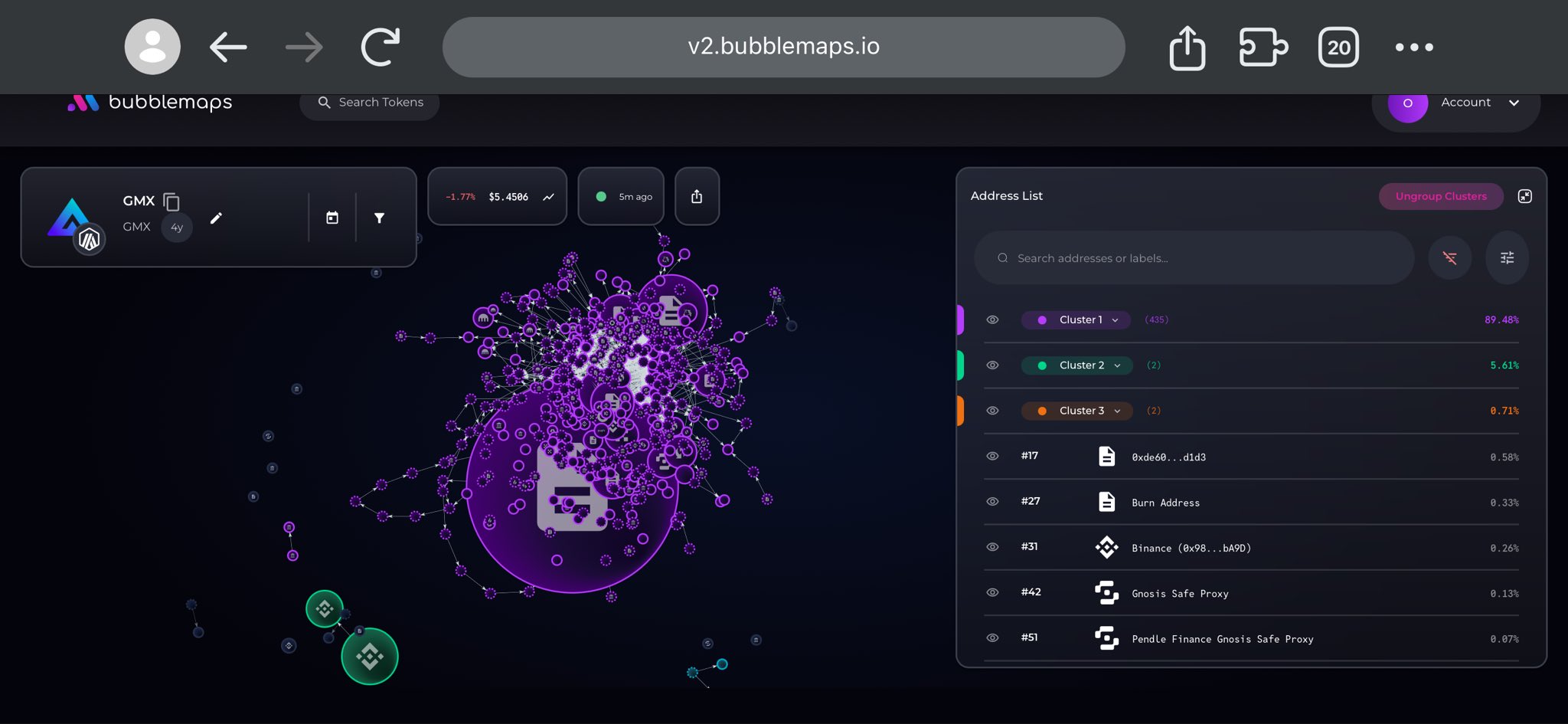
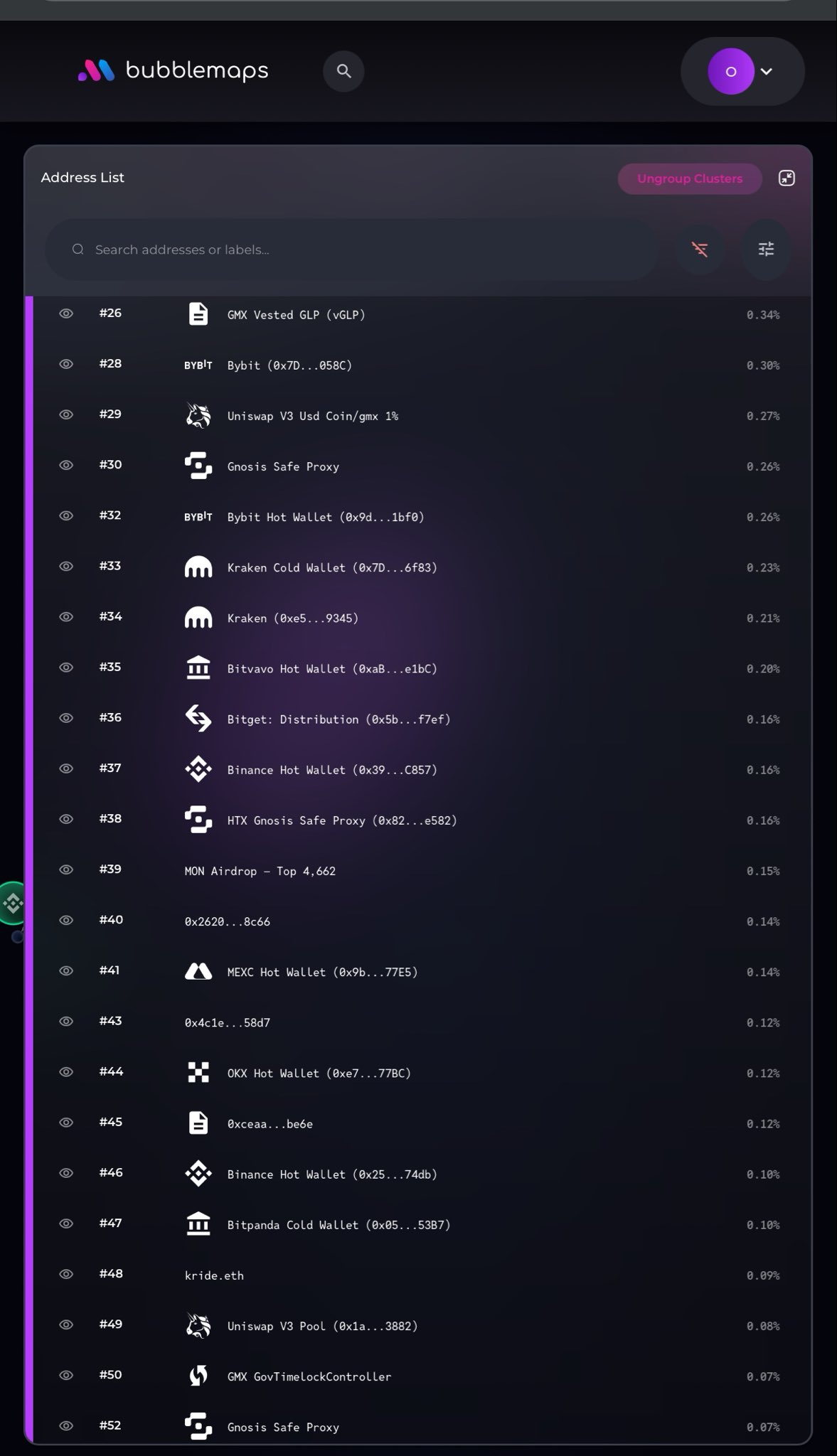
Bubblemaps V2 is now live on Arbitrum First thing I did was pull up $GMX and the breakdown is fascinating. Cluster 1 holds 89.48% across 435 wallets, but when you dig into it, it makes sense. The GMX protocol contract itself sits at #1 with 56.07%, followed by GMX_LockboxAdapter at 6.43%, Uniswap V3 Pool at 2.53%, and the Staked GMX contract at 2.33%. This isn’t whale manipulation, it’s protocol-owned and staked supply doing what it’s supposed to. What’s more interesting is the exchange exposure. Inside the cluster you’ve got OKX at 1.40%, Binance Hot Wallet at 1.02%, Gate_io at 0.63%, and Kraken Cold Wallet at 0.50%. Scroll further and it gets even more diverse; Bybit, Bitvavo, Bitget, MEXC, Bitpanda, HTX all showing up as holders. Literally every major CEX has $GMX exposure. Also spotted a MON Airdrop entry and kride.eth, which adds a retail layer on top of all the institutional presence. The picture here is clean. No hidden clusters, no suspicious wallets dominating - just a mature, widely distributed token with deep exchange and protocol backing. This is what healthy on-chain distribution looks like Check it yourself → https://t.co/BaA7amYIpo 🫧
 Bubblemaps OnChain_Analyst Media B280.91K @bubblemaps
ARBITRUM IS LIVE ON BUBBLEMAPS See holders, whales, and clusters behind @arbitrum tokens Try it now: https://t.co/PdHLxIauG1 https://t.co/4DyI5HrcUn
 21 17 455 Original >Trend of GMX after releaseBullishGMX on-chain distribution is healthy and mature, with no whale manipulation, and is widely distributed across protocols and exchanges.
- Jordi in Cryptoland D12.08K @lordjorx
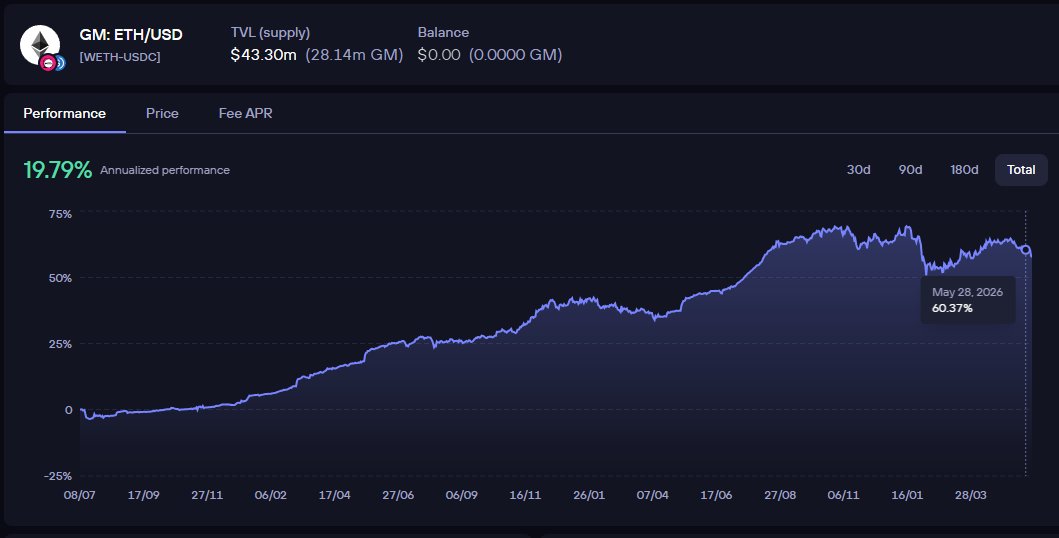
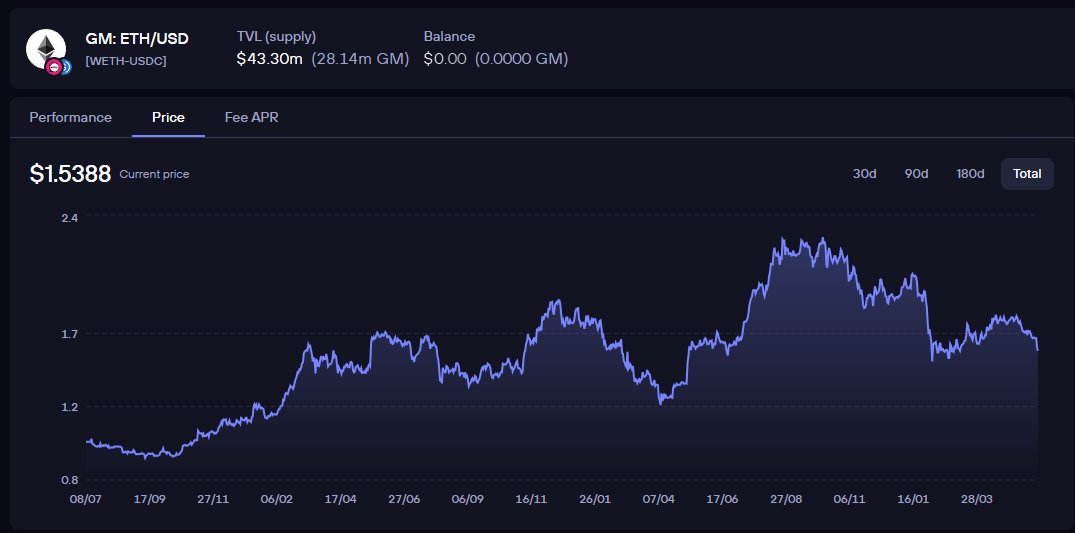
I missed the best LP benchmark in DeFi. @JasonvuTech from @brownfiamm told me something I didn't know: @GMX_IO, the first perpetuals protocol to popularize revenue sharing, benchmarks its pools against @Uniswap v2. The outperformance charts are public and the gap is insane. I've been using the wrong reference point entirely. > I honestly don't know if there are structured products on top of GMX that hedge the 50% volatile exposure. Do you? BrownFi v2's original pitch was that LPs earned more than simply holding the underlying 50/50 pair. That worked well until October's crash, where it basically stopped. > BrownFi v3 is adding more customization layers with the explicit goal of competing against both benchmarks; not just v2 but GMX too. The benchmark was always there. I just wasn't looking at the right chart.
 42 7 9.94K Original >Trend of GMX after releaseBullishTweet analysis of DeFi lending and LP strategies, highlighting GMX's significant outperformance compared to Uniswap, and exploring new risk models like Dolomite.
  DeFi Dad ⟠ defidad.eth Educator DeFi_Expert C180.53K @DeFi_Dad
Did you know in early Sept 2022, GMX was up 221% while BTC was down 57% at the same point in the bear market? I keep seeing these calls for a new era in crypto markets, where good tokens and teams aren't held prisoner by their correlation to BTC. I want this too, my frens. So badly. But this pattern of outperformance and calls for celebrating, it is not new. In fact, it's eerily similar to what we saw last bear market. So imo, not a whole lot has changed this time around. Let me take you down memory lane in 2022... GMX: It is the clearest example of this outperformance narrative I can recall. GMX was only down ~23% from its ATH during the 2022 bear market where most tokens lost 80-90%. After falling to a low around $25 following FTX's collapse in Nov 2022, GMX rallied~90% into year-end while the overall crypto market was cooked, down more than 60% for the year. The narrative for self-custodial onchain perps was growing in the aftermath of FTX's failing. And GMX was the hottest token for its fee revenue. (see chart below, GMX was the hottest thing ever, I remember losing my mind over what they represented to real DeFi adoption, better tokenomics, and their insane performance while BTC was at new year lows, sub-$30k). LDO: Another one of the best narrative trades during the 2022 bear market! In July 2022, LDO gained ~375% in a single month after Ethereum devs confirmed The Merge would happen in Sept 2022. Then, LDO had a second shorter run, in early Jan 2023 as the Shanghai upgrade (enabling staked ETH withdrawals) drew closer. RPL: Similar liquid staking narrative as LDO but less dramatic, and shorter run of outperformance, while BTC languished. For example, in early 2023, RPL gained ~23% while BTC was mostly flat. RPL also had a strong run heading into The Merge in summer 2022 for same reasons as LDO. I'm still ultra bullish HYPE and I'm sure as hell not shorting any of the big movers lately like ZEC, NEAR, VVV but I'm just reminding you: these are normal bear market things happening. FYI: I would disclose shorts if I had them open. I sincerely hope all your bags go up 😉 But this is a small reality check from someone who's lived through these crypto market cycles over and over and I am kinda surprised how shocked some are that any tokens are doing so well while BTC, and most of the crypto majors have been in downtrend since Oct 2025.
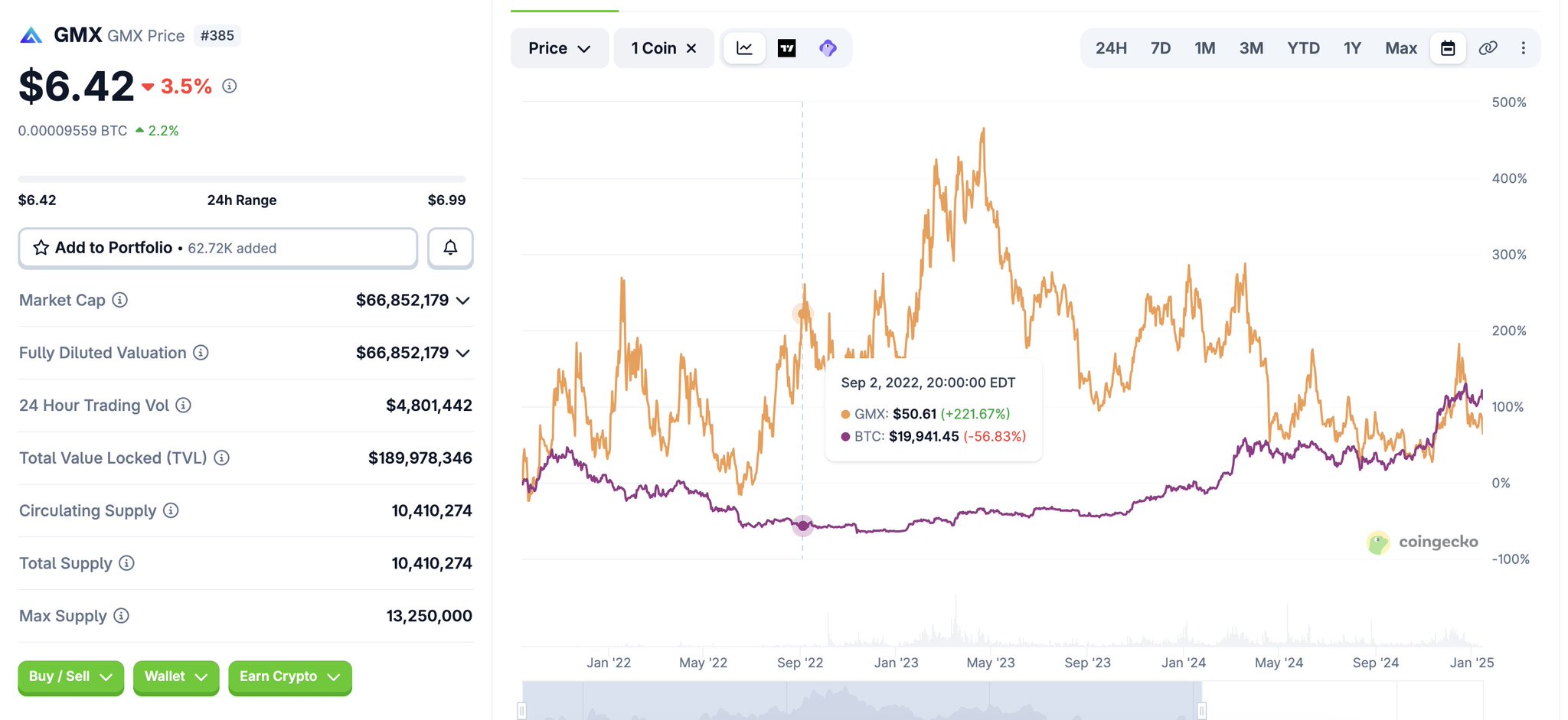 66 9 6.58K Original >Trend of GMX after releaseNeutralIn a bear market, some altcoins perform exceptionally, but the author warns this is not a new normal and we need to be wary of market narratives.
- DeFi Dad ⟠ defidad.eth Educator DeFi_Expert C180.53K @DeFi_Dad
Did you know in early Sept 2022, GMX was up 221% while BTC was down 57% at the same point in the 2022 bear market? I keep seeing these calls for a new era in crypto markets, where good tokens and teams aren't held prisoner by their correlation to BTC. I want this too, my frens. So badly. But this pattern of outperformance and calls for celebrating, it is not new. In fact, it's eerily similar to what we saw last bear market. So imo, not a whole lot has changed this time around. Let me take you down memory lane in 2022... GMX: It is the clearest example of this outperformance narrative I can recall. GMX was only down ~23% from its ATH during the 2022 bear market where most tokens lost 80-90%. After falling to a low around $25 following FTX's collapse in Nov 2022, GMX rallied~90% into year-end while the overall crypto market was cooked, down more than 60% for the year. The narrative for self-custodial onchain perps was growing in the aftermath of FTX's failing. And GMX was the hottest token for its fee revenue. (see chart below, GMX was the hottest thing ever, I remember losing my mind over what they represented to real DeFi adoption, better tokenomics, and their insane performance while BTC was at new year lows, sub-$30k). LDO: Another one of the best narrative trades during the 2022 bear market! In July 2022, LDO gained ~375% in a single month after Ethereum devs confirmed The Merge would happen in Sept 2022. Then, LDO had a second shorter run, in early Jan 2023 as the Shanghai upgrade (enabling staked ETH withdrawals) drew closer. RPL: Similar liquid staking narrative as LDO but less dramatic, and shorter run of outperformance, while BTC languished. For example, in early 2023, RPL gained ~23% while BTC was mostly flat. RPL also had a strong run heading into The Merge in summer 2022 for same reasons as LDO. I'm still ultra bullish HYPE and I'm sure as hell not shorting any of the big movers lately like ZEC, NEAR, VVV but I'm just reminding you: these are normal bear market things happening. FYI: I would disclose shorts if I had them open. I sincerely hope all your bags go up 😉 But this is a small reality check from someone who's lived through these crypto market cycles over and over and I am kinda surprised how shocked some are that any tokens are doing so well while BTC, and most of the crypto majors have been in downtrend since Oct 2025.
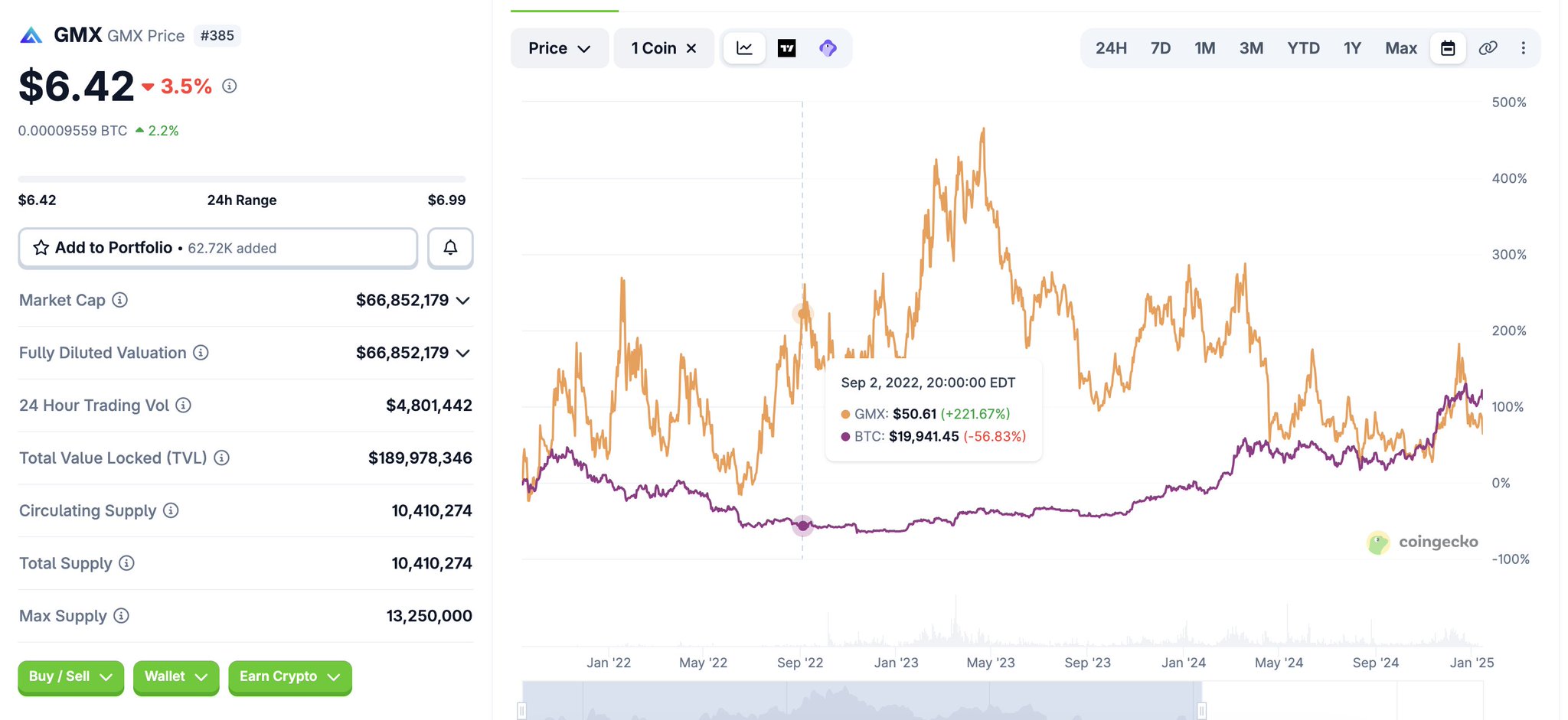 14 0 807 Original >Trend of GMX after releaseBearishOutperformance of some altcoins over Bitcoin in a bear market is a common phenomenon and does not indicate a broad market recovery.
  Emperor Osmo 🐂 🎯 OnChain_Analyst FA_Analyst C92.63K @FlowslikeosmoEmperor Osmo 🐂 🎯 OnChain_Analyst FA_Analyst C92.63K @Flowslikeosmo
Revenue sharing token mentions on CT are up 4x this week. Most people can name Hyperliquid. Nobody has mapped the full list. This is the most complete breakdown of DeFi protocols sharing revenue with holders ever posted on X. Bookmark this. —— PERPS & DERIVATIVES: The Biggest Payers @HyperliquidX: $51M paid to holders last month with an 89% fee retention. The single most capital-efficient revenue-sharing protocol in DeFi. @edgeX_exchange: $22.0M last month +190%. Paying out more in holder revenue than total protocol revenue. Subsidizing early holders intentionally. @lighter_xyz: $2.1M last month trading at a $338M market cap with a 2.2x P/F ratio, it is the most undervalued perp on this list. @gmx: $550K last month, the original revenue-sharing perp, three years running. @GainsNetwork_io: $178K last month, hosting 200+ synthetic assets, with every trade paying gToken holders directly. —— DEX & SPOT TRADING: Volume That Pays You @AerodromeFi: $3.8M paid to $veAERO holders last month. More holder reven
56 15 4.34K Original >Trend of GMX after releaseBullishDeFi revenue-sharing protocols see massive earnings surge, GMX and AERO benefit OGAudit🛡️Crypto Reviews Customodi myen BAB The C22.39K @OGAudit
OGAudit Web3 Research: @GMX_IO $GMX - The $300B DEX That Added Oil and Gas Perps? GMX has been building permissionless onchain derivatives since 2021 and now operating across four chains with 100x leverage and a commodity derivatives suite: - GMX runs on Arbitrum, Avalanche, Botanix and MegaETH supporting up to 100x leverage via isolated GM pools and auto-rebalancing GLV vaults, using Chainlink Data Streams for sub second oracle pricing ensuring liquidations occur only at fair market prices. $300B in cumulative trading volume, 1M+ users and 80+ ecosystem integrations make GMX a foundational DeFi base layer. - GMX launched 24/7 perpetual markets for WTI crude oil, Brent crude and Natural Gas powered by Chainlink Data Streams, targeting commodity hedgers with permissionless 24/7 trading from self-custody wallets. MegaETH Terminal integration adds trading incentive points for perps, referrals and GLV liquidity provision. - The founding team is entirely anonymous, a consistent governance risk for a protocol managing $300B+ in cumulative volume. Stakers earn 63% of all protocol fees from trading, liquidations, borrowing and swaps on Arbitrum and Avalanche which is one of the highest revenue share ratios in DeFi. Is $300B in proven volume, 1M+ users, commodity perps, near zero dilution and 63% fee share to stakers the DeFi derivatives protocol with the strongest fundamental case at a $66M market cap or does Hyperliquid’s orderbook model capturing market share, a 93.6% ATH decline, anonymous team and $66M market cap representing a fraction of one month’s GMX trading volume confirm that onchain volume does not equal token value? Category: Decentralized Exchange (DEX) Coin Name: $GMX Circulating Supply: 10.40M Market Cap: $66.11M Market Cap Rank: #410 OG (Trust) Score: 34.87 OG Score Rank: #355/1358 Reviewed by 7 OG Auditors. See the Social Audit with Reviews by crypto OG’s and more on the $GMX Coin page: ogaudit(.)com/crypto/gmx-gmx https://t.co/AM0FJOEE5E

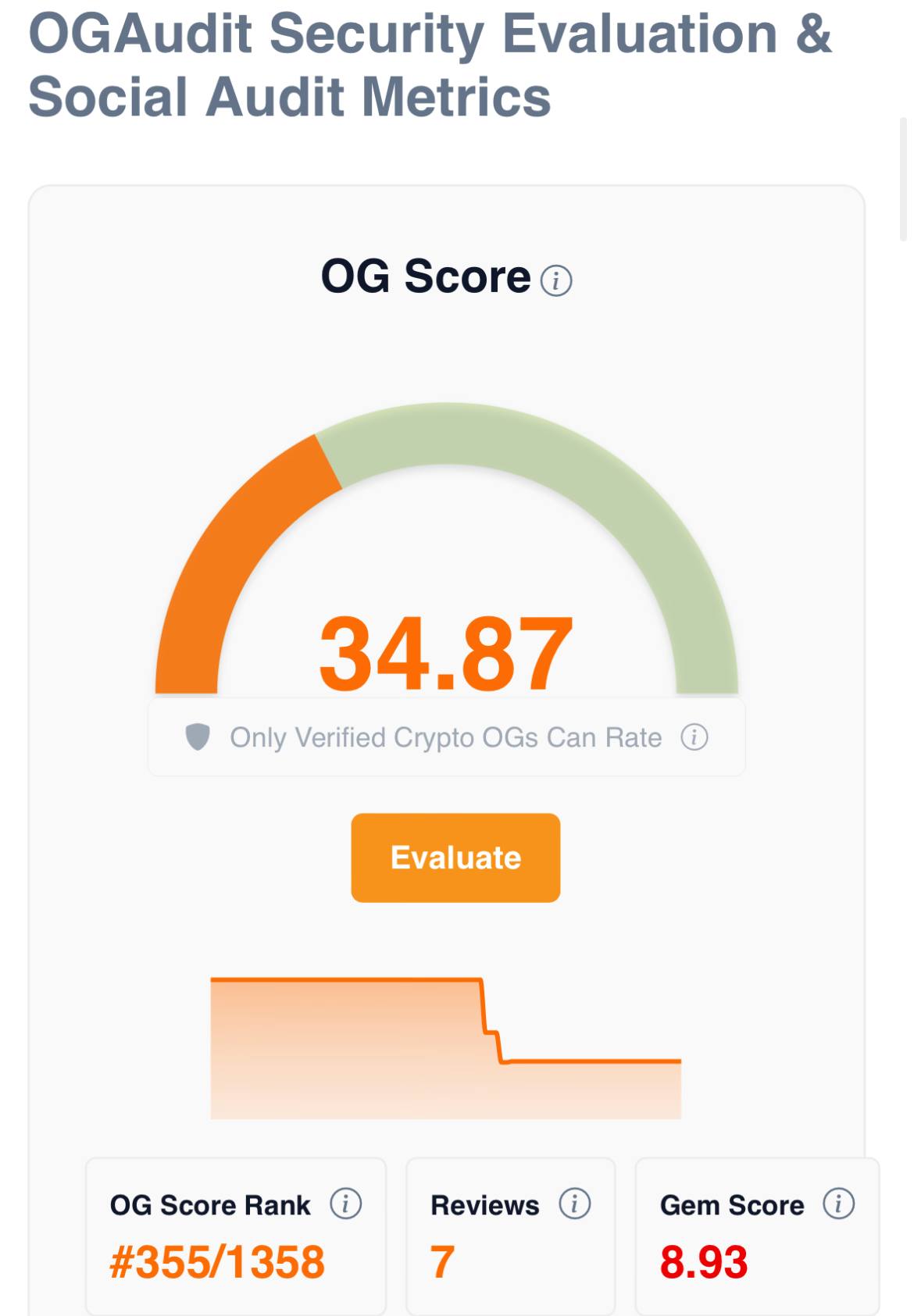 13 1 193 Original >Trend of GMX after releaseBearishGMX's operating data is impressive, but the anonymous team, value decoupling, and low audit score pose risks.
 wale.moca 🐳 OnChain_Analyst Tokenomics_Expert B175.21K @waleswoosh
MegaETH Terminal is shutting down, but we're ending the season with a banger. +29,000 points and a top #30 rank. Overall, I lost about $5k USD, with the biggest losses coming from Hitone (-$1k USD), Monster (-$1k USD) and GMX (-$2.5k USD due to liquidation). So now I'm hoping for at least $0.25 per point, so it wasn't all a complete waste of time. Overall, there are actually some good apps on there. I still think shutting down the Terminal is a mistake tho
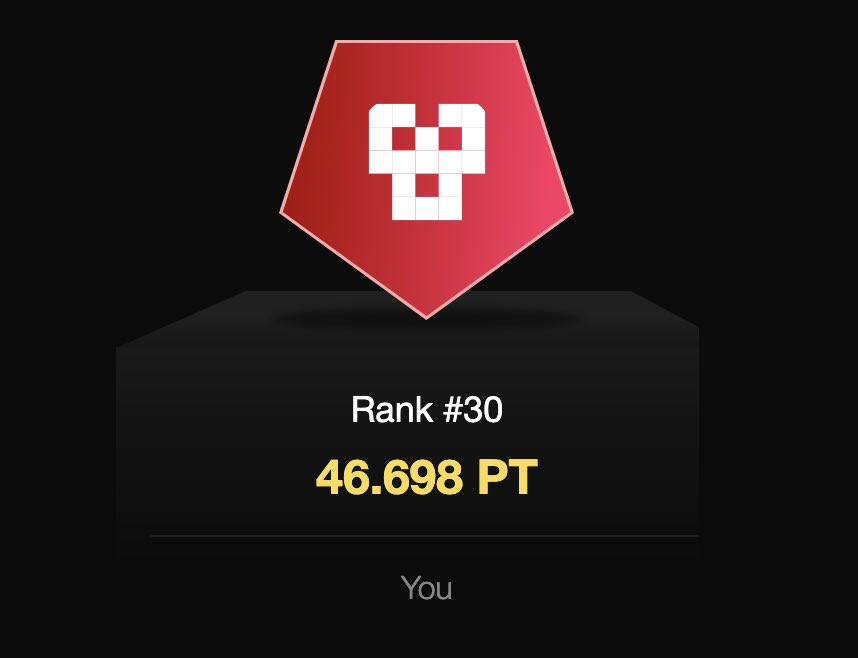 513 246 48.31K Original >Trend of GMX after releaseBearishUser lost $5k in the MegaETH Terminal event, criticized its mechanism, and is hopeful about MEGA's price.
 加密韋馱|Skanda 🔶 Founder Derivatives_Expert B54.40K @thecryptoskanda
I've seen many people possibly misunderstand the non‑orderbook perp DEX Jupiter/GMX. They think that centralized contracts without KYC like Hyperliquid, which correspond to "AMM exchanges," are generational replacements. But that's completely wrong. 1. First, the execution logic of Jupiter/GMX is not an "AMM curve" (that belongs to the older @perpprotocol). Instead, an oracle pulls prices from a price source, and the LP pool acts as the counterparty for trades. In theory, this type of exchange can align with the price source without slippage. For example, CME gold futures; oracle‑based perp DEXs can directly match its quotes. Whether it's an order book like Hyperliquid or a CFD model like @variational_io, they all need to "arbitrage" prices over, essentially acting as intermediaries moving price differences. However, GMX adds a "price impact" to guard against timing differences caused by price propagation and block times, preventing arbitrage. 2. What truly makes GMX/Jupiter impressive is their ability to create assets. Many people don't realize that, in the realm of contract trading, so‑called "real‑world assets" essentially don't exist. Your opening and liquidation prices have no relation to the liquidity of the underlying assets in the real world; they are provided by the contract's pricing mechanism (order book/oracle, etc.). So if you like to criticize "lack of underlying value support" as gambling, you can now fire at order book exchanges. But GMX/Jupiter are different; their liquidity comes from LP pools. LPs, acting as counterparties for all trades, collect all client losses and trading fees and redistribute them proportionally – essentially the house edge of a Macau casino. This is a truly yield‑generating asset. Moreover, these pools can be used as counterpart‑risk‑free structured finance, collateral for DeFi nesting, and arbitrage trades. Jupiter's JLP used to be the largest source of arbitrage trades and profits on Solana. When @DriftProtocol had issues, many didn't understand its purpose—it was then one of the biggest providers of JLP neutral arbitrage strategies. Such capability is unavailable to order book exchanges. Centralized exchange vaults, including HLP, are essentially active market‑making strategies—like handing your funds to a centralized black box. Using HLP as collateral essentially transfers counterparty risk. 3. Irreplaceable business logic based on the binary nature of "betting against the pool". Uniswap has already shown that the LP pool mechanism provides an irreplaceable efficiency advantage for issuing long‑tail assets—no order book to date can replace the same mechanism as Uniswap/pump/fourmeme. This is not an efficiency issue; it's a market‑making cost issue, and I'm not just talking about cold starts—how can an order book exchange recover all counterparty P&L and trading frictions? If you didn't understand, you can go back and check my tweets on polymarket and propAMM. The real issue with GMX and Jupiter may be that they consider only the traders' perspective, not the upstream market demand—a fundamental difference from Hyperliquid. Nevertheless, you can check the DefiLlama rankings; regardless of how top‑ranked order books game the rankings, GMX/Jupiter's volume and revenue are barely affected. If they were more aggressive, their performance would improve, but this already proves they are irreplaceable.
78 66 12.85K Original >Trend of GMX after releaseBullishGMX/Jupiter provide zero‑slippage counterparties through LP pools, offering irreplaceable value. Jabz Founder Regulatory_Expert C2.34K @jabranthelawyer
Fixed. https://t.co/DkaDH9A6QQ

 L3o D4.18K @GadgetLeo
Which of these is the worst project in the history of web3? https://t.co/olQrunKpj1
 1 1 90 Original >Trend of GMX after releaseExtremely BearishThe tweet lists several Web3 projects as the worst projects in Web3 history.
 toly 🇺🇸 Founder Dev D1.65M @toly
War? In this economy? https://t.co/l9lmyXrmZH
 Lochie D17.23K @lochie_sol
The Perps DEX war is getting BRUTAL. New players are stealing market share and established platforms are struggling to keep dominance. Here’s 3 well known perps platforms that have been hit👇 https://t.co/XBN6MxUTST
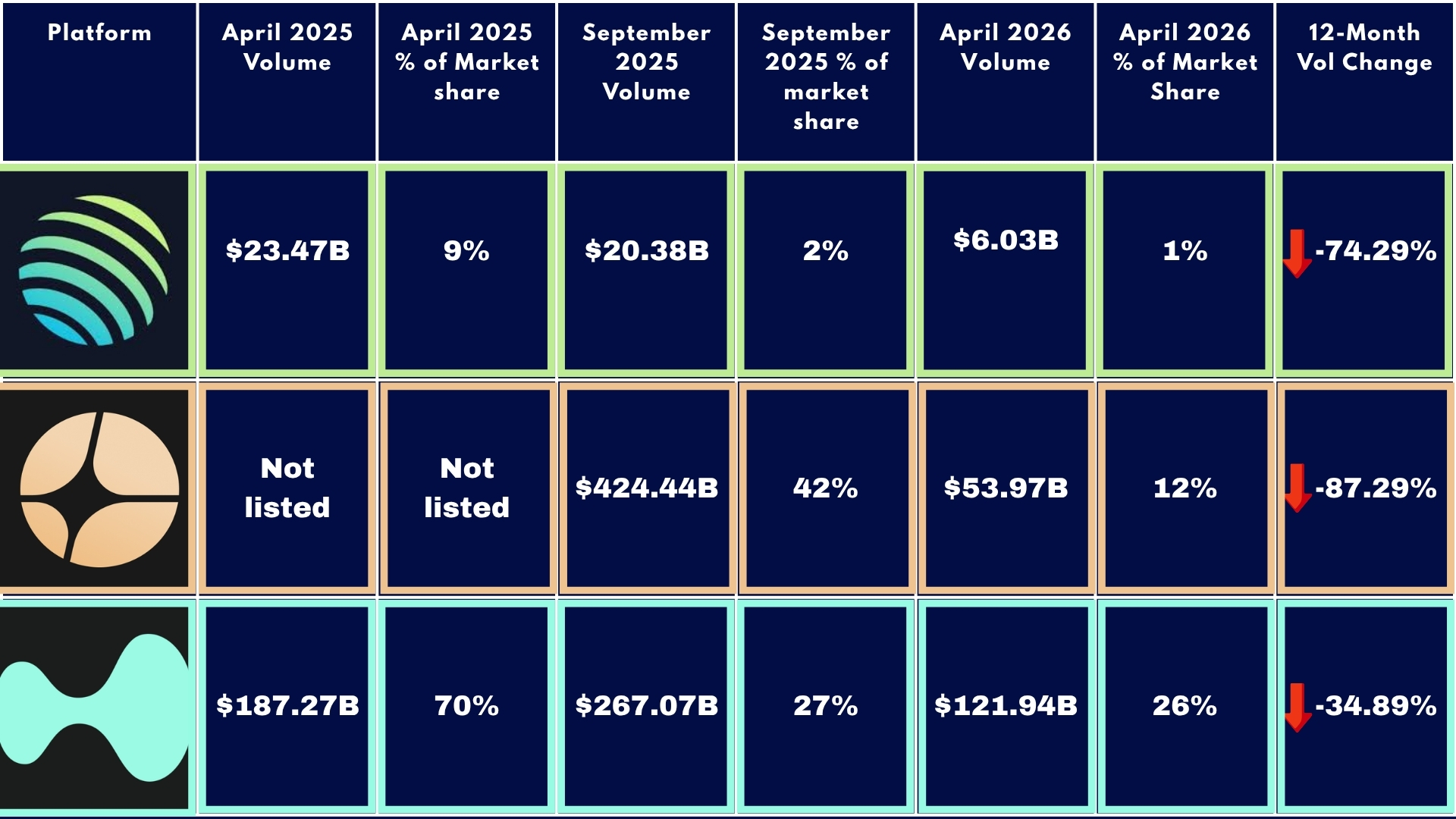 7 0 743 Original >Trend of GMX after releaseExtremely BearishPerps DEX competition is fierce, and established platforms such as GMX, DYDX, SNX have seen a sharp decline in trading volume and market share.

- No Data