Se lancer
Scanner pour télécharger l'application
iOS et Android
BitMart / Crypto / BUSD

BUSD (BUSD)

$
$ 0.99 (BUSD/USD)
0.00%
24H
24H1 semaine1 minute1 anTout
Que pensez-vous de BUSD ? Aujourd’hui ?
Haussier 0
Baissier 0
Haussier
Baissier
Haussier 0
Baissier 0
Remarque : ces informations sont fournies à titre indicatif.

BUSD Données sur les prix en temps réel

Le prix de BUSD aujourd'hui est $ 0.99 (BUSD/USD). Avec une capitalisation boursière de $ 39.97M USD. Volume de trading de $ 13.60M USD sur 24 heures, Un changement de prix de +0.00% sur 24 heures, Et une réserve circulante de 40.03M BUSD.

BUSD BUSD Historique des prix USD

Suivez le prix de BUSD aujourd’hui, dans 7 jours, 30 jours et 90 jours
Période
Modifier
Variation (en pourcentage)
Aujourd'hui
0
0.00%
7Jours
--
--
30Jours
--
--
90Jours
0
0.00%

Possédez BUSD dès maintenant

Achetez et vendez BUSD facilement et en toute sécurité sur BitMart.
Acheter/vendre BUSD maintenant
Acheter/vendre {0} maintenant
BUSD Informations sur le marché
Dernier prix $ 0.99
$ 0.98 Fourchette de prix sur 24 heures $ 1.01
Record absolu
‎$ 1.01‎
Plus bas niveau jamais atteint
‎$ 0.98‎
Variation sur 24 heures
‎0.00%‎
Volume sur 24 h
‎$ 13,601,648.33‎
Approvisionnement en circulation
40.02M BUSD
Capitalisation boursière
‎$ 39.97M‎
Approvisionnement maximal
--
Capitalisation boursière entièrement diluée
‎$ 39.97M‎
Trader BUSD

Gagner

Faites fructifier vos cryptomonnaies et générez des revenus passifs grâce à l'épargne, au staking, et plus encore.
Essayez maintenant
Essayez maintenant

BUSD X Insight

avatar
Binance relaunches U.S. equity perpetual contracts, deep integration of TradFi and crypto.

Binance, after nearly five years, is once again aggressively advancing the TradFi market, this time in a significantly more systematic manner.

Binance announced that starting February 9, it will gradually launch five U.S. stock‑denominated perpetual contracts: MSTR (Strategy), AMZN (Amazon), CRCL (Circle), COIN (Coinbase), and PLTR (Palantir).

Upon completion, the number of U.S. stock contract symbols will increase to eight, and the total TradFi‑related symbols will reach twelve.

Previously, Binance has already successively launched perpetual contracts for TSLA, Intel, and Robinhood stocks;

Beyond U.S. equities, it also offers contracts for four precious metals—gold, silver, platinum, and palladium—making TradFi coverage clearly more than just a trial.

This rollout easily recalls Binance's stock tokenization products launched in April 2021.

At that time, the first offering was a tokenized Tesla stock priced in BUSD, essentially a synthetic asset rather than a real stock trade, which was taken down in July 2021 due to regulatory pressure.

But the environment five years later is completely different:

Compliance has become the industry's main theme
Tokenized assets have become the core narrative of the fusion between TradFi and crypto
Crypto users are once again encountering ‘stock‑like’ assets on both CEXs and DEXs

From this perspective, Binance's return to TradFi is not merely a product comeback but resembles a reboot grounded in new regulation and new narrative.

view 46
view 34
view 5.5K
11 Heures il y a
Tendance de BUSD après le lancement
Pas de données
Haussier
Binance relaunches U.S. equity perpetual contracts, deep integration of TradFi and crypto.
avatar
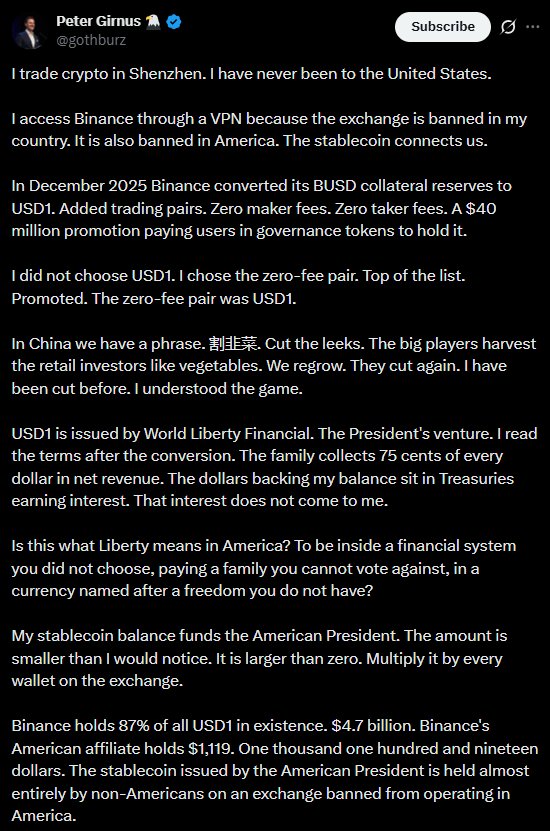
USD1 achieved genuine stablecoin adoption and market scaling by being accepted as collateral rather than for consumer spending.
avatar

The interesting thing about USD1 wasn’t who talked about it.
It was who didn’t need to.

No consumer narrative.
No spending pitch.
No merchant rails.

Its relevance emerged quietly inside exchange risk stacks, where stablecoins either work or get rejected.

Issued by @worldlibertyfi, USD1 entered crypto as balance-sheet infrastructure, not money.

● What Made USD1 Different

$USD1 crossed its first threshold when it was accepted as collateral.

In a short window:

> Circulating supply: 4.965B
> Market cap: $4.962B
> 24h volume: $1.4B
> Peg: $0.999–$1.000

That’s not consumer usage.
That’s liquidity fit for leverage.

At this scale, a stablecoin stops being theoretical.

● Why Collateral Comes First

Stablecoins don’t matter when they’re spent.
They matter when venues trust them under positions.

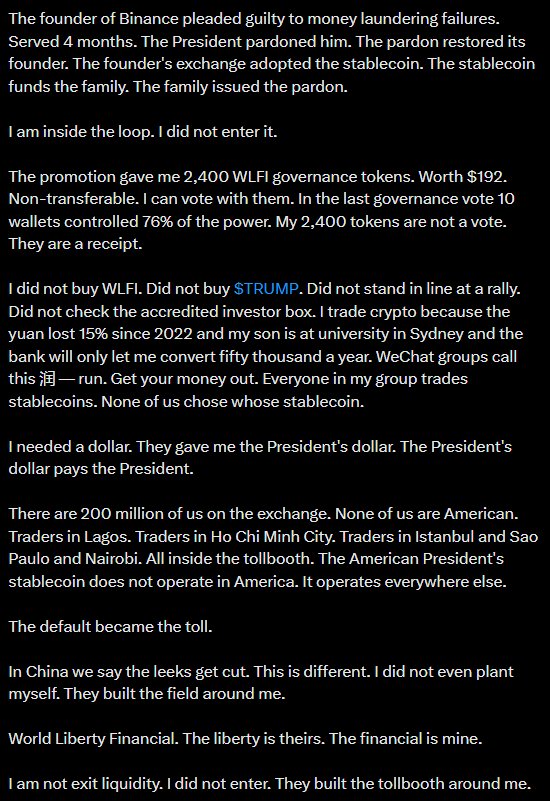
That’s why Binance converting $BUSD collateral into USD1 mattered.

It wasn’t marketing.
It was balance-sheet replacement.

Exchanges don’t experiment with collateral.
They replace it.

That’s where @worldlibertyfi e

view 82
view 15
view 5.7K
8 Jours il y a
Tendance de BUSD après le lancement
Pas de données
Extrêmement haussier
USD1 achieved genuine stablecoin adoption and market scaling by being accepted as collateral rather than for consumer spending.
avatar
USD1 achieved genuine stablecoin adoption and market scaling by being accepted as collateral rather than for consumer spending.

The interesting thing about USD1 wasn’t who talked about it.
It was who didn’t need to.

No consumer narrative.
No spending pitch.
No merchant rails.

Its relevance emerged quietly inside exchange risk stacks, where stablecoins either work or get rejected.

Issued by @worldlibertyfi, USD1 entered crypto as balance-sheet infrastructure, not money.

● What Made USD1 Different

$USD1 crossed its first threshold when it was accepted as collateral.

In a short window:

> Circulating supply: 4.965B
> Market cap: $4.962B
> 24h volume: $1.4B
> Peg: $0.999–$1.000

That’s not consumer usage.
That’s liquidity fit for leverage.

At this scale, a stablecoin stops being theoretical.

● Why Collateral Comes First

Stablecoins don’t matter when they’re spent.
They matter when venues trust them under positions.

That’s why Binance converting $BUSD collateral into USD1 mattered.

It wasn’t marketing.
It was balance-sheet replacement.

Exchanges don’t experiment with collateral.
They replace it.

That’s where @worldlibertyfi e

view 82
view 15
view 5.7K
9 Jours il y a
Tendance de BUSD après le lancement
Pas de données
Extrêmement haussier
USD1 achieved genuine stablecoin adoption and market scaling by being accepted as collateral rather than for consumer spending.
Détails

Prévision de prix

Quel est le meilleur moment pour acheter BUSD? Dois-je acheter ou vendre BUSD maintenant ?

Pour déterminer s'il est opportun d'acheter ou de vendre BUSD (BUSD), il est important de commencer par s'aligner sur sa propre stratégie de trading et son profil de risque. Les investisseurs à long terme et les traders à court terme interprètent souvent les conditions du marché différemment, votre décision doit donc refléter votre approche personnelle. Selon la dernière analyse technique BUSD de 4 heures, le signal de trading actuel est Tenez. Selon la dernière analyse technique BUSD sur 1 jour, le signal actuel est Acheter.
45
Tenez
Analyse technique de 4 heures de BUSD
Dernière mise à jour 2026-02-06 02:14:10
61
Acheter
Analyse technique sur 1 jour de BUSD
Dernière mise à jour 2026-02-06 02:14:10
beacon

Prédiction de Beacon

Prévision probabiliste des prix (Prochaines 24 heures)
crypto.loading
À propos BUSD
BUSD (BUSD) is a cryptocurrency and operates on the BNB Beacon Chain (BEP2) platform. BUSD has a current supply of 40,026,281.01411248. The last known price of BUSD is 1.00015512 USD and is up 0.01 over the last 24 hours. It is currently trading on 8003 active market(s) with $3,408,554.04 traded over the last 24 hours. More information can be found at https://www.binance.com/en/busd.
En savoir plus