Stablecoin issuer Mandela Digital announced receiving a $5 million investment from Datavault AI (NASDAQ: DVLT). The funds and technology will be used to accelerate the development and launch of Mandela Dollar (MUSD), a 1:1 USD‑backed stablecoin aimed at providing inclusive finance, cross‑border remittances, and digital payment services to the unbanked or underbanked populations in the Global South and other regions. Datavault AI will provide Mandela Digital with an AI‑driven platform, tokenization patents, SanQtum quantum‑secure encryption, and RWA infrastructure support. https://t.co/3dbHsVlCnL
Comprar cripto
tarjeta
Comercio P2P
Compra USDT en un marketplace
Tarjeta de crédito/débito
Compre criptomonedas con Visa o MasterCard
Pago vía prestadores
Compre criptomonedas a través de MoonPay, Simplex y más
Tarjeta BitMart
Impulsando su experiencia con las criptomonedas
Tarjeta prepago de criptomonedas
Obtenga una Mastercard lista para usar al instante
Comerciar
USDⓈ-M
Utilizando USDⓈ como colateral
COIN-M
Utilizando la propia moneda como colateral
TradFi
Trading integral para metales, acciones y forex
Operativa de demostración
Aprenda a operar con riesgo cero
Resumen de futuros
Plataforma única para todo lo relacionado con futuros
Rey de Futuros
Pool de premios de 478 000 USDT
Crecer
Resumen de Earn
Activos inactivos, gane con facilidad
Ahorros
Gane intereses conservando su portafolio.
Staking
Staking sencillo, cuantiosas retribuciones.
Gestión de patrimonio
Aumente su riqueza con un equipo de activos top
RWA
Mantenga BMRUSD, disfrute del rendimiento
Exclusivo VIP
Gane de forma estable para usuarios VIP
Rewards
Centro de recompensas
Descubra recompensas exclusivas por valor de hasta 14 000 USDT
LaunchPrime
Una plataforma para lanzar tokens y NFT
Programa de afiliados
Únase para ganar cuantiosas comisiones
Powerdrop
¡La solución AirDrop de próxima generación ya está AQUÍ!
Centro de eventos
El centro unificado para todas las operaciones de trading
Sorteo diario de futuros
100 % de probabilidades de ganar con operaciones diarias
Sorteo diario de Spot
Gane 8888 USDT en grandes premios
Recarga móvil
Recargue móviles de forma fácil, online y segura
Send
Send money globally, fast and secure
BitMart Mall
Viva de las criptomonedas

MetaMask USD (mUSD)
$ 0.99 (mUSD/USD)
0.00%
24H
MetaMask USD Datos de precios en tiempo real
El precio de hoy de MetaMask USD es de $ 0.99 (mUSD/USD). Con una capitalización de mercado de $ 18.15M USD. Volumen de trading en 24 horas de $ 1.27M USD, Un cambio de precio en 24 horas de +0.00%. Y un suministro circulante de 18.16M mUSD.
MetaMask USD mUSD Historial de precios USD
Siga el precio de MetaMask USD para hoy, 7 días, 30 días y 90 días
Periodo
Cambiar
Cambio (%)
Hoy
$ 0
0.00%
7días
$ 0
0.00%
30días
$ 0
0.00%
90días
$ 0
0.00%
Sea propietario de mUSD ahora
Compra y vende mUSD fácil y seguro en BitMart.
MetaMask USD Información de mercado
$ 0.99 Autonomía de 24 horas $ 0.99
Máximo histórico
$ 1.10
El mínimo histórico
$ 0.74
Cambio en 24 h
0.00%
Volumen en 24 h
$ 1,272,110.62
Suministros en circulación
18.15M
mUSD
Market Cap
$ 18.15M
Suministro máximo
--
Capitalización de mercado totalmente diluida
$ 18.15M
Trade mUSD
Ganar
Pon a trabajar tus criptomonedas inactivas y obtén ingresos pasivos a través de ahorros, staking y más.
MetaMask USD X Insight

吴说区块链
Media
Influencer
D
 179.0K @wublockchain12
 Alcista
MUSD receives $5 million investment, accelerating launch, providing financial services for unbanked users
 4
4
 1
1
 3.2K
3.2K
2026-07-23 11:52
Tendencia de mUSD tras el lanzamiento
Alcista
MUSD receives $5 million investment, accelerating launch, providing financial services for unbanked users

Cointelegraph
Media
Influencer
D
2.9M @Cointelegraph Alcista
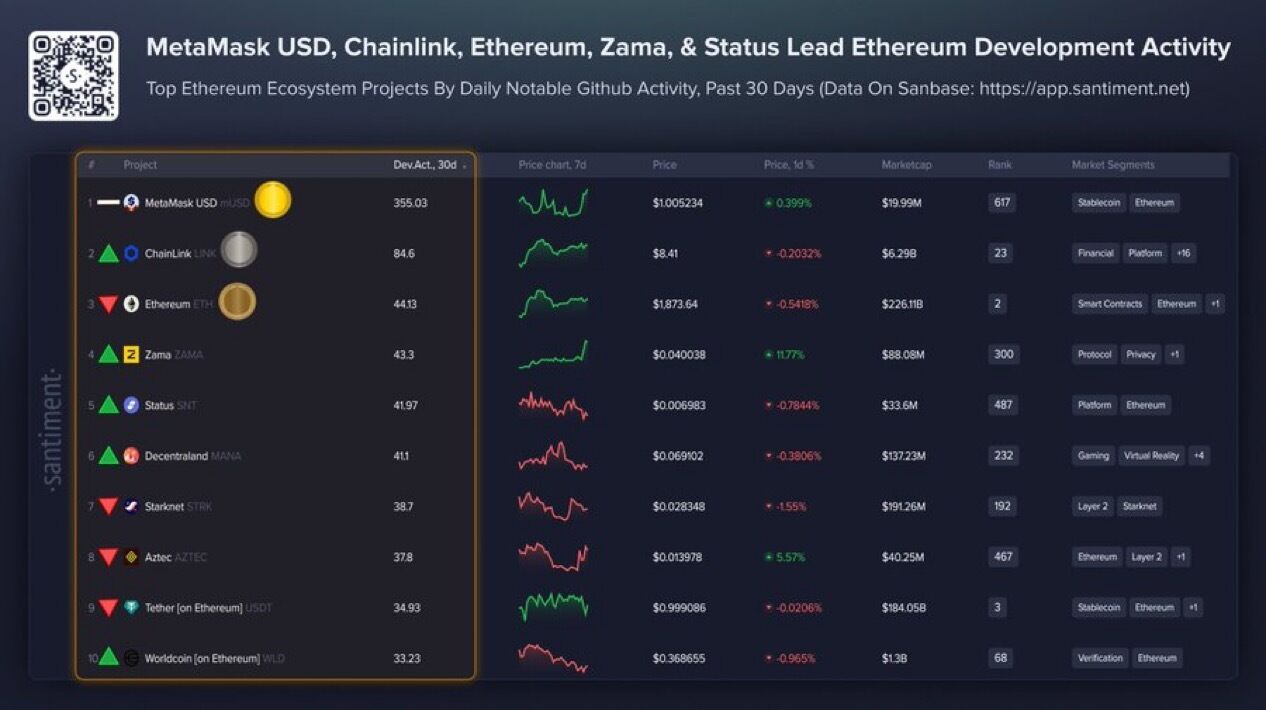
MetaMask, Chainlink, and Ethereum rank in the top three of the Ethereum ecosystem by development activity.
🔥 LATEST: MetaMask, Chainlink, and Ethereum ranked as the top three Ethereum ecosystem projects by development activity, according to Santiment. https://t.co/GNxm2y4ubh
 399
51
55.7K
399
51
55.7K
2026-07-20 22:22
Tendencia de mUSD tras el lanzamiento
Alcista
MetaMask, Chainlink, and Ethereum rank in the top three of the Ethereum ecosystem by development activity.

shine.di
Founder
Influencer
A
2.5K @Shine0x Alcista
DirolLabs successfully integrated MentoLabs, providing optimal routing and FX services for mUSD and stablecoins on Monad.

Dirol D
8.1K @DirolLabsX We have successfully integrated @MentoLabs to provide the best routes for mUSD and other stablecoins on Monad.
Mento extends FX rails to Monad for payments, treasury flows, remittances, and multicurrency apps, with cross-chain connectivity via @wormhole. https://t.co/NLL3vWxw5N
 13
4
251
13
4
251
2026-07-14 19:17
Tendencia de mUSD tras el lanzamiento
Alcista
DirolLabs successfully integrated MentoLabs, providing optimal routing and FX services for mUSD and stablecoins on Monad.
Predicción de precios
¿Cuándo es un buen momento para comprar mUSD? ¿Debería comprar o vender mUSD ahora?
Al decidir si es un buen momento para comprar o vender MetaMask USD (mUSD), es importante ajustarse primero a su propia estrategia de trading y perfil de riesgo. Los inversores a largo plazo y los traders a corto plazo suelen interpretar las condiciones del mercado de forma diferente, por lo que su decisión debe reflejar su enfoque personal. Según el último análisis técnico de 4 horas de mUSD, la señal de trading actual es Comprar. Según el último análisis técnico de 1 día de mUSD, la señal actual es Hold.

Predicción de Beacon
Pronóstico probabilístico de precios (próximas 24 horas)Descargo de responsabilidad de la predicción de Beacon
Los resultados de los datos que se muestran en esta página se analizan en función de los datos de trading reales (OHLCV) del par de trading seleccionado junto con los indicadores técnicos correspondientes.
Esta predicción es un producto técnico experimental y se proporciona solo con fines de referencia. No constituye un consejo de inversión. Los acontecimientos inesperados del mundo real pueden influir significativamente en el comportamiento del mercado. Por tanto, los traders deben tomar decisiones con precaución.
Esta predicción es un producto técnico experimental y se proporciona solo con fines de referencia. No constituye un consejo de inversión. Los acontecimientos inesperados del mundo real pueden influir significativamente en el comportamiento del mercado. Por tanto, los traders deben tomar decisiones con precaución.
Sobre MetaMask USD
MetaMask USD (mUSD) is a cryptocurrency and operates on the Ethereum platform. MetaMask USD has a current supply of 18,155,745.922001. The last known price of MetaMask USD is 0.99676262 USD and is down -0.06 over the last 24 hours. It is currently trading on 28 active market(s) with $11,004,774.65 traded over the last 24 hours. More information can be found at https://metamask.io/price/metamask-usd.
Leer más
Enlaces oficiales
Explorador de blockchain