口座開設
QRコードでアプリをダウンロードする
iOS & Android

Sender (ASI)

$
$ 0.00071 (ASI/USD)
-28.00%
24H
24時間週足月足1年最大
How Do You Feel About ASI? today?
強気 0
弱気 0
強気
弱気
強気 0
弱気 0
Note: This information is for reference only.

Sender ASI Price History USD

Track the price of Sender for today, 7 days, 30 days and 90 days
期間
24H変動幅
24H変動率 (%)
本日
0
-28.00%
7日
--
--
30日
--
--
90日
0
-68.13%

Own ASI Now

Buy and sell ASI easily and securely on BitMart.
Buy/Sell ASI Now
Buy/Sell {0} Now
Sender 相場情報
最終取引価格 $ 0.00071
$ 0.00070 24H変動幅 $ 0.00099
過去最高値
‎$ 0.089‎
過去最安値
‎$ 0.00070‎
24H変動幅
‎-28.00%‎
24H取引高
‎$ 37,212.51‎
供給量
0.00 ASI
時価総額
‎$ 0‎
最大供給量
1.00B ASI
完全希薄化後時価総額
‎$ 719.03K‎
取引 ASI

稼ぐ

眠っている暗号資産を活用し、セービングやステーキングで安定収益を獲得。
今すぐ試す
今すぐ試す

Sender Xインサイト

avatar
The tweet notes that identifying the cycle top for cryptocurrencies is difficult, most coins are underperforming, and the market faces a long-term bear risk.

It is really hard to point out the "cycle top" of this cycle

You have most alts that topped in March 24.

Then you have many such as Doge that topped in Dec 24.

Then you have stuff like ETH that "topped" in August 25 while it remains within a macro range and BTC in Oct 25

All while Doge & ETH never went for a price discovery this "cycle", while BTC was in a bull market until Oct 25 but has been underperforming macro stuff (with which it competes) for nearly 2 years

Pick a winner 🤷‍♂️

avatar

@i_am_jackis If you just look at the timing then Nov 2024 was a top. Now it just remains to be seems if we are into another bear market for a other year or two or if the four year cycle is broken and 2026 is bullish for alts and a lot break their ath

view 154
view 24
view 19.5K
34 日 前
リリース後のASIのトレンド
データなし
弱気
The tweet notes that identifying the cycle top for cryptocurrencies is difficult, most coins are underperforming, and the market faces a long-term bear risk.
avatar
Tweet detailed analysis of the three major decentralized AI projects ASI, QUBIC, and TRAC, bullish on their growth potential.

The Decentralized AI Race.

Forget L1 memecoins, AI compute is where serious capital is moving this cycle.

Could these three break into the $1B club?

→ @ASI_Alliance ( $FET )
→ @_Qubic_ ( $QUBIC )
→ @origin_trail ( $TRAC )

Are these the next 10x of decentralized AI? 👇

⚪ ASI ( $FET ): The Artificial Superintelligence Alliance

✦ Architecture → Autonomous Agents + Modular AI Chain

ASI is the merger of https://t.co/EBpcX5azxg (FET), SingularityNET (AGIX), and CUDOS, forming a unified AI ecosystem with a shared ASI token.

At its core, ASI combines:

• Autonomous AI Agents from https://t.co/EBpcX5azxg agents that execute tasks, negotiate, trade, or coordinate across chains.

• SingularityNET’s marketplace enabling AI models and services to be published, monetized, and composed.

• CUDOS’ decentralized compute layer bringing GPU/TPU workloads and verifiable compute.

Together, they form a modular network where agents, models, data, and compute plug into a unified AI economy.

The big shift?

Instead of models living in silos, ASI wants AI components to talk to each other, trade value, and scale into something resembling an open AGI substrate.
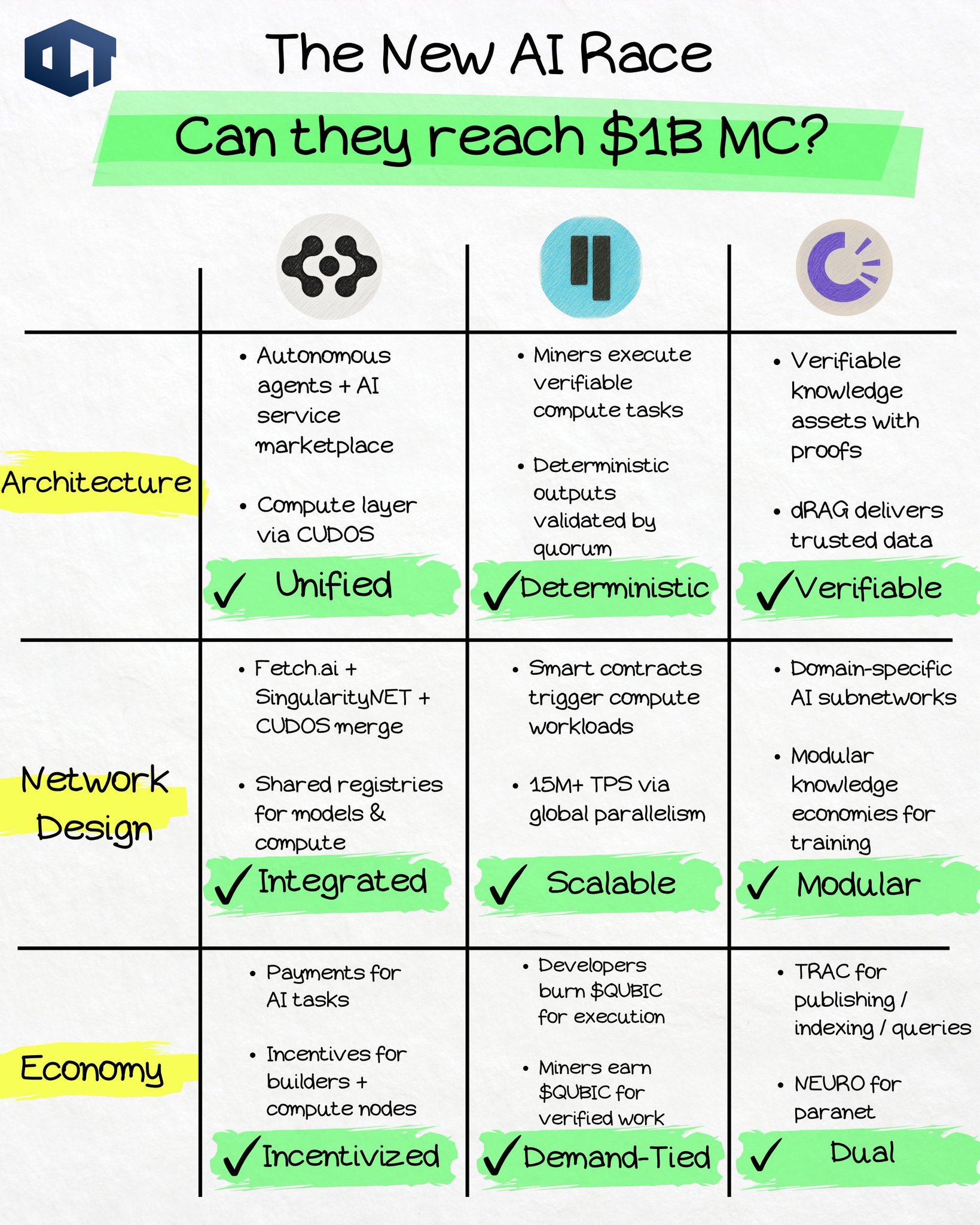
✦ Utility → Agents, Marketplaces, Compute

ASI focuses on usable AI, not just infrastructure.

• Agentverse → deploy on-chain + off-chain agents that automate trading, logistics, and workflows.

• AI Marketplace → models listed as services, payable via ASI.

• Compute Layer (CUDOS) → offloads heavy inference and training to distributed GPU clusters.

• Data Layer → Ocean-inspired, but not merged ASI integrates verifiable data markets for training inputs.

What makes ASI interesting is the interoperability:

Agents can call models, models can request compute, compute can pull verifiable data all within one token economy.

It’s the closest thing crypto has to an “AI operating system.”

✦ Economy → $ASI Migration + Shared Incentives

The ASI migration unified: FET + AGIX + CUDOS → ASI under a ~2.63B supply.

Token roles include:

• Payment for agent execution
• Rewards for compute providers
• Governance over model registries
• Incentives for marketplace usage
• Staking for network security

The design aligns all contributors agents, model creators, compute providers, and data suppliers into one incentive loop.

👉 My take: ASI is the “everything layer” for decentralized AI agents, models, compute, and data under one roof. It has the cleanest narrative and widest scope, but delivering on the AGI vision will be its challenge.

🟢 Qubic ( $QUBIC ): Turning Mining Into AI Compute

✦ Architecture → Useful Proof-of-Work + AI Quorum

Where ASI focuses on agents and marketplaces, Qubic focuses on raw compute.

Its innovation is Useful Proof-of-Work (UPoW) instead of hashing, miners perform verifiable computational tasks like:

• AI inference
• Model evaluations
• Encryption tasks
• Scientific computations

Every computation is validated by a global quorum a decentralized verification layer ensuring correctness without trusting miners.

This makes Qubic one of the only networks where the act of mining directly produces AI work.

✦ Utility → Deterministic Compute + AI Execution

Qubic is effectively a deterministic AI mainframe.

• Smart contracts trigger off-chain compute tasks
• Miners solve them and return proofs
• Network reaches quorum and finalizes results

This allows:

✔ AI agents
✔ LLM inference
✔ Game logic
✔ Scientific simulations
✔ Real-world compute outsourcing

2025 milestones include:

• Monero mining via Qubic (demonstrating UPoW flexibility)
• TOKEN2049 demo of deterministic AI compute
• 15.52M TPS benchmark verified by CertiK

Qubic isn’t trying to be an L1 it’s trying to be an AI supercomputer powered by miners, which makes its economic model fascinating.

✦ Economy → $QUBIC Utility + Burn-for-Compute

Qubic’s model is extremely simple:

• Miners earn $QUBIC for completing tasks
• Users and applications burn $QUBIC to access compute
• Burning ties network demand directly to token scarcity

This makes $QUBIC one of the few AI tokens with real resource backing compute is the commodity, token burns are the pricing mechanism.

👉 My take: Qubic is the highest-risk, highest-upside play if UPoW becomes a standard, Qubic becomes the decentralized compute engine. If not, it stays experimental.

🔵 OriginTrail (TRAC): The Verifiable Internet for AI

✦ Architecture → Decentralized Knowledge Graph (DKG) + dRAG

Where ASI deals with agents and Qubic handles compute, TRAC solves a different AI problem:

AI hallucinations.

OriginTrail’s DKG structures data into verifiable knowledge assets:

• Provenance
• Authenticity
• Blockchain-backed proofs
• Cross-chain indexing

Then, dRAG (decentralized Retrieval Augmented Generation) lets AI models pull information from trusted sources before answering.

In plain language:

➡️ “Don’t guess check the facts first.”

TRAC is building a verifiable memory layer for AI.

✦ Utility → Paranets + Knowledge Economies

OriginTrail introduced Paranets domain-specific subnetworks for sectors like:

• Supply chains
• Pharma
• Real-world assets
• Scientific knowledge
• AI training datasets

Each paranet is run by its own community, with its own incentives, validators, and governance but all plug into the global DKG.

This modular structure allows the DKG to scale horizontally while keeping data specialized and trusted.

✦ Economy → $TRAC + $NEURO Dual Token

OriginTrail uses two tokens:

• $TRAC → indexing, publishing, querying, and securing knowledge assets
• $NEURO → paranet rewards, governance, and emissions

Demand grows as:

• Enterprises publish more data
• Paranets expand
• AI applications integrate dRAG
• More knowledge markets go live

👉 My take: TRAC is the “truth layer” for AI the one that ensures AI systems aren’t confident liars.

🔚 Conclusion: The AI Edge

Each project attacks a different weakness in AI:

• ASI → Autonomous agents, compute marketplace, model economy
• Qubic → Deterministic compute powered by UPoW
• TRAC → Verifiable knowledge and hallucination prevention

Together, they form a full stack:

Knowledge → Compute → Agents.

📊 Final Rankings

AI Infrastructure

$ASI > $QUBIC > $TRAC

ASI spans agents, models, compute, R&D, and governance. Qubic excels in compute. TRAC is specialized around data verifiability.

Scalability & Execution Model

$QUBIC > $ASI > $TRAC

UPoW enables parallel deterministic compute. ASI’s agent + compute modules scale well. TRAC scales via paranets but depends on adoption.

Real-World Utility

$TRAC > $ASI > $QUBIC

TRAC already secures supply chains & enterprise datasets. ASI integrates consumer and enterprise AI apps. Qubic’s utility depends on developer adoption.

💡 My Takeaway

If you want broad AI infrastructure exposure → ASI
If you want compute as a commodity → Qubic
If you want verifiable AI that doesn’t hallucinate → TRAC

Each plays a role in the coming autonomous AI economy.

view 97
view 5
view 4.9K
83 日 前
リリース後のASIのトレンド
データなし
強気
Tweet detailed analysis of the three major decentralized AI projects ASI, QUBIC, and TRAC, bullish on their growth potential.
avatar
GeoStaking is optimistic about the ASI Alliance and the future of decentralized AI, believing its fundamentals are strong and it represents the next wave of AI.
avatar

GeoStaking Statement: Why We’re Bullish on the ASI Alliance and the Future of Decentralised AI

In the wake of recent discussion and speculation surrounding the ASI Alliance, GeoStaking wanted to double down on why we remain deeply optimistic - not just about the Alliance, but about the future of Decentralised Artificial Intelligence (DeAI) as a whole.

Because while the noise continues, the fundamentals have never looked stronger.

From AI’s Past to DeAI’s Future

Artificial Intelligence has already changed the world.
But the first wave was centralised - controlled by corporations, driven by profit, powered by data they didn’t own.

The next wave - DeAI - is something entirely different:
a transparent, community-owned system where compute, data, and models live on decentralised infrastructure.
It’s AI that serves everyone, not just a few.

And the ASI Alliance represents the most credible path to that reality - bringing together pioneers in decentralised compute, agentic frameworks, and AI interoperability t

view 214
view 19
view 37.0K
88 日 前
リリース後のASIのトレンド
データなし
非常に強気
GeoStaking is optimistic about the ASI Alliance and the future of decentralized AI, believing its fundamentals are strong and it represents the next wave of AI.
詳細確認

価格予測

When is a good time to buy ASI? Should I buy or sell ASI now?

When deciding whether it’s a good time to buy or sell Sender (ASI), it’s important to first align with your own trading strategy and risk profile.Long-term investors and short-term traders often interpret market conditions differently, so your decision should reflect your personal approach. According to the latest ASI 4-hour technical analysis, the current trading signal is Hold. According to the latest ASI 1-day technical analysis, the current signal is 購入.
56
Hold
4-hour technical analysis of ASI
Last Update 2026-02-06 09:46:55
61
購入
1-day technical analysis of ASI
Last Update 2026-02-06 09:46:55
beacon

ビーコン予測

Probabilistic Price Forecast (Next 24 Hours)
crypto.loading
アプリバージョン Sender
Sender (ASI) is a cryptocurrency launched in 2024and operates on the Near platform. Sender has a current supply of 1,000,000,000 with 0 in circulation. The last known price of Sender is 0.00128026 USD and is down -4.74 over the last 24 hours. It is currently trading on 5 active market(s) with $174,370.01 traded over the last 24 hours. More information can be found at https://www.sender.org/.
続きを読む